Explore Professional Email Powered by OX App Suite →
What You Need Before You Start
A working OX App Suite setup depends on three things being ready before you touch the admin panel: domain ownership access, a decision on mailbox count, and a reseller account through which the service is provisioned. Skipping any one of these turns a ten-minute task into a support ticket.
 Domain Access and Registrar Requirements
 Domain Access and Registrar Requirements
You need login access to whichever registrar or DNS host manages your domain’s zone file, because every subsequent step, MX records, SPF, DKIM, requires editing records there. GoDaddy, Cloudflare, Namecheap, and enterprise registrars like MarkMonitor all support the record types OX App Suite needs. However, the interface for adding a TXT record with a long DKIM string varies enough that it’s worth having the login handy rather than requesting it mid-setup. If your domain was registered by a web developer or a previous IT contractor years ago, tracking down that access is often the slowest part of onboarding, even slower than the actual mailbox configuration.
Domain verification typically consists of a single TXT record that OX App Suite asks you to add temporarily, confirming that you control the domain before mailboxes are activated on that domain. This step exists to prevent someone from provisioning email on a domain they don’t own, and it typically resolves within an hour of the record propagating. However, propagation can occasionally take up to 24 hours, depending on your registrar’s TTL settings. Business owners moving off a previous host sometimes conflate this verification step with the full MX cutover, which is a separate action covered later; the two should not happen simultaneously if you want zero mail downtime.
Reseller Provisioning and Licensing Model
OX App Suite is not typically sold directly to end businesses; it’s distributed through a reseller-managed licensing structure in which a partner like Hiya Digital provisions the mailbox tier, storage allocation, and add-on modules on your behalf via their partner control panel. This model means your invoice, support contact, and account management run through the reseller rather than Open-Xchange directly, which in practice means faster response times for day-to-day issues since you’re not waiting in a queue behind enterprise-tier infrastructure customers.
The licensing structure also determines what you can self-serve versus what requires a reseller ticket. Mailbox creation and password resets are usually self-service via the admin panel. At the same time, plan-tier changes, domain additions beyond your initial allotment, or storage pool expansions are often routed through the reseller’s provisioning team. Understanding this split before setup prevents the common frustration of hunting for a setting that isn’t exposed at the customer admin level by design, since the reseller model intentionally keeps certain infrastructure controls centralized.
DNS Records: MX, SPF, DKIM, and DMARC Setup
Four DNS record types control whether OX App Suite receives your mail and whether recipients trust it enough to deliver it to the inbox: MX for routing, SPF for sender authorization, DKIM for message signing, and DMARC for policy enforcement. Misconfiguring any one silently degrades deliverability rather than causing an obvious error.
MX Record Configuration and Priority Values
The MX record tells the internet which mail server accepts messages for your domain, and it requires both a hostname (provided by your OX App Suite reseller) and a priority value, where lower numbers are tried first. Most single-provider setups use a single MX record with a priority of 10. However, businesses running a secondary spam-filtering layer or a backup mail server sometimes maintain two MX records with staggered priorities, such as 10 and 20. Getting the priority wrong doesn’t break mail flow outright if there’s only one record. Still, it becomes a real problem the moment a second MX entry is added without understanding the ordering.
Propagation time for MX changes is the most common source of “my email isn’t working” panic during a cutover, since DNS changes can take anywhere from a few minutes to 48 hours to fully propagate across all resolvers globally, depending on the previous record’s TTL value. A practical mitigation is lowering the TTL on your existing MX record to around 300 seconds a day or two before the planned cutover, so that when you do make the switch, the old, cached record expires quickly instead of lingering in resolver caches and causing intermittent delivery to the old server for hours after you’ve already moved.
SPF, DKIM, and DMARC Authentication Records
SPF (Sender Policy Framework) is a TXT record listing which mail servers are authorized to send on your domain’s behalf. It’s governed by RFC 7208, which caps the record at 10 DNS lookups, a limit that trips up businesses who’ve accumulated SPF includes from old marketing tools, a defunct CRM, and a previous email provider all in the same record, pushing them over the ceiling and causing SPF to fail validation entirely rather than partially. DKIM (DomainKeys Identified Mail) works differently: OX App Suite provisions a per-domain cryptographic key pair, publishing the public key as a TXT record at a selector-specific subdomain while signing outgoing mail with the private key, so recipients can verify that the message wasn’t altered in transit and that it genuinely originated from an OX-authorized sender.
DMARC builds on both by telling receiving mail servers what to do when SPF or DKIM checks fail: reject, quarantine, or monitor and report. It’s the record most businesses skip entirely, leaving their domain vulnerable to spoofing even after SPF and DKIM are correctly configured. A conservative rollout starts DMARC in monitoring mode (p=none) with an aggregate report address, letting you review a week or two of authentication data before tightening the policy to quarantine or reject, which avoids the scenario where a legitimate but misconfigured sending source, a help desk tool, or an invoicing platform, suddenly finds its mail rejected the moment DMARC enforcement goes live.
Mailbox Provisioning and the OX App Suite Admin Panel
Once DNS is verified, mailbox creation happens inside the OX App Suite admin panel, where storage quotas, aliases, and permission levels are set per user rather than applied uniformly across the domain. This granularity is useful for businesses with mixed roles; a shared support inbox needs different permissions than an executive’s primary account.
Creating Mailboxes and Assigning Storage Quotas
Each new mailbox in the admin panel requires a username, an initial password (or an invite link, depending on how the reseller has configured onboarding), and a storage quota drawn from the domain’s overall pool rather than a fixed per-mailbox allocation. This pooled-quota approach means a 500GB domain allocation can be split into 50GB for an executive account and 5GB each for 10 support staff, and can be adjusted later without purchasing additional storage, which is a meaningful advantage in flexibility over flat per-seat storage caps that some competing platforms enforce.
Bulk provisioning matters for businesses onboarding more than a handful of users at once, and OX App Suite’s admin panel supports CSV-based bulk creation. Hence, an IT administrator isn’t manually clicking through twenty individual mailbox forms. The practical bottleneck at this stage is rarely the platform itself but rather internal data collection. Getting a finalized list of names, desired usernames, and department groupings before provisioning starts avoids the messy cleanup of renaming mailboxes or merging duplicate accounts after users have already started sending mail from them.
Mailbox-Level Permission Model and Admin Roles
OX App Suite separates account administration into distinct permission tiers: a domain admin who can create and delete mailboxes across the entire domain, a group admin scoped to a specific department or team, and individual users who can manage only their own account settings. This mailbox-level permission model matters for businesses that want an office manager handling day-to-day mailbox resets without giving that person the ability to alter DNS-linked domain settings or billing information, a separation that flat, single-admin platforms often don’t offer without an enterprise-tier upgrade.
Assigning the wrong permission tier is a common early mistake, giving every department head domain-admin rights “to save time”, and it tends to surface months later when someone accidentally deletes a shared calendar resource or modifies a mailbox quota they didn’t understand the implications of changing. A tighter default, where most staff sit at the standard user tier and only one or two people hold domain-admin rights, mirrors how most IT teams already structure access to other business systems and avoids retrofitting permissions after an incident.
Ten-Minute Setup Walkthrough
The actual mailbox activation, once DNS and licensing are sorted, follows a short numbered sequence inside the admin panel. Most of the ten minutes referenced in this walkthrough cover active clicks, not propagation waiting time, which happens in the background while other setup tasks continue.
Step-by-Step Activation
 Step-by-Step Activation
1. Log into the reseller-provisioned OX App Suite admin panel using the credentials issued after your partner account setup.
2. Add and verify your domain using the temporary TXT verification record described earlier.
3. Create your first mailbox by assigning a username, password, or invite link, and a storage quota from your domain’s pool.
4. Publish the MX record pointing to your OX App Suite mail server hostname.
5. Add SPF, DKIM, and DMARC TXT records using the values generated in the admin panel.
6. Enable OX Drive provisioning for the mailbox if document storage and sync are part of your plan.
7. Send a test message from an external account and confirm that it arrives without a spam folder flag.
OX Drive Provisioning During Initial Setup
OX Drive, the file storage and sync component bundled with most OX App Suite tiers, is provisioned per mailbox during this same setup flow rather than as a separate product activation. Enabling it at this stage means the storage quota you assigned earlier is shared between mail and Drive files unless the reseller’s plan tier separates them, which is worth confirming before a user starts syncing large files and unexpectedly eats into their mailbox headroom. Desktop and mobile Drive clients authenticate using the same mailbox credentials, so there’s no separate account creation step once the mailbox itself exists.
Businesses that don’t need file sync can leave OX Drive dormant without it affecting mail delivery or the mailbox’s core functionality, since the components are modular rather than tightly coupled. The more common scenario, though, is enabling it during initial setup because the marginal effort is minimal, a checkbox in the same provisioning screen, and retrofitting it for an already-active user base later means a second wave of client installs and sync configuration that’s easier to avoid by bundling it into day one.
Anti-Spam and Anti-Virus Filtering Configuration
Inbound filtering determines what actually reaches a user’s inbox versus what’s quarantined or rejected outright, and OX App Suite deployments typically layer SpamExpert-style filtering with OX Guard for message-level encryption, addressing two different threats: unwanted mail volume and message confidentiality.
Spam and Virus Filtering Layers
SpamExpert-style filtering operates at the mail-flow level, scanning inbound messages against reputation databases, content heuristics, and attachment scanning before a message ever reaches the mailbox, which is a meaningfully different approach from client-side spam folders that sort mail after it’s already been delivered and consumed storage quota. This pre-delivery filtering reduces the load on individual mailbox quotas. It catches malicious attachments before a user has a chance to open them, which matters more for businesses without dedicated IT staff to monitor inbound threats in real time.
Renewal reviews commonly surface a stale SPF that nobody remembers adding, usually from a marketing platform or CRM trial from years earlier, and it’s worth checking that alongside spam filter tuning, since an overly permissive SPF record can undermine even well-configured inbound filtering by letting spoofed mail pass authentication checks it shouldn’t. Filter aggressiveness is typically adjustable per domain or per mailbox, with a default setting that catches obvious spam without false-positiving legitimate marketing or transactional mail. However, businesses in industries prone to false positives, such as recruiting and sales outreach, often need a slightly looser default and a documented process for released messages.
OX Guard Encryption for Sensitive Messages
OX Guard adds end-to-end encryption and digital signing on top of standard TLS-in-transit protection, letting users encrypt individual messages using PGP-based key pairs generated and managed within the OX App Suite interface rather than requiring a separate encryption client. This matters for businesses in regulated industries, healthcare, legal, and financial services, where standard TLS protects mail in transit between servers but doesn’t prevent someone with server-level access from reading message content, a gap OX Guard closes for messages where that level of protection is explicitly required.
In practice, adoption tends to be selective rather than domain-wide: most businesses enable OX Guard for specific users or departments that handle sensitive correspondence, rather than encrypting every outgoing message, since recipients without a compatible PGP setup on their end may struggle to decrypt an OX Guard message without guidance. A short internal policy that specifies which message types require encryption and a quick recipient-side decryption guide resolve most of the friction that otherwise makes OX Guard feel more complicated than it actually is once configured.
| Security Feature | Applies At | Default State | Configurable Per Mailbox |
|---|---|---|---|
| SpamExpert-style filtering | Pre-delivery, mail-flow level | Enabled | Yes |
| OX Guard encryption | Message level (opt-in per send) | Disabled | Yes |
| TLS/STARTTLS in transit | Server-to-server | Enabled | No |
| DKIM signing | Outbound, per-domain key | Enabled after DNS setup | No |
| Attachment virus scanning | Pre-delivery | Enabled | Limited |
| Two-factor authentication | Login/session | Optional, admin-enabled | Yes |
| DMARC policy enforcement | Domain-wide | Not set by default | Yes |
| IP-based login restriction | Session/access | Disabled | Yes, admin tier only |
Choosing Hiya Digital as Your OX App Suite Partner
Getting spam filtering and OX Guard configured correctly the first time, rather than discovering a permissive SPF include or a missed DMARC policy months into using the domain, is exactly where working with an authorized partner pays off. Hiya Digital, as a certified OX App Suite reseller, handles this configuration alongside the initial setup rather than leaving it as a follow-up task. A short consultation can confirm that your domain’s filtering and encryption settings match your industry’s actual requirements.

Mobile Device Sync and Native Client Behavior
Mobile access to OX App Suite mail, calendar, and contacts happens two ways: through the dedicated OX Mail mobile app or through native device mail clients configured via standard protocols, and the two behave differently enough that the choice affects day-to-day usability.
OX Mail App vs. Native Device Client Setup
The OX Mail app, available for iOS and Android, connects using an OX-optimized sync protocol that supports push notifications, unified inbox management across multiple accounts, and direct access to OX Drive files from within the mail interface, features that don’t carry over when a user instead configures their phone’s built-in mail app using generic IMAP and SMTP settings. Native client setup is still fully supported and often preferred by users who don’t want a separate app cluttering their home screen. Still, it typically means that calendar and contacts sync require separate CalDAV and CardDAV configurations, rather than being bundled, since the dedicated app handles it automatically.
The practical trade-off comes down to how tightly integrated a user wants calendar, contacts, files, and mail to feel versus using tools they’re already comfortable with. Sales and field staff who live in their calendar throughout the day generally get more value from the dedicated app’s unified experience. In contrast, users who mainly check mail and rarely use shared calendars often find native client setup perfectly sufficient and slightly faster to configure, since it usually only requires entering a mail address and password for autodiscovery to complete the rest.
Push Notification and Offline Access Behavior
Push notifications work reliably through the OX Mail app because it maintains a persistent connection optimized for OX App Suite’s infrastructure. At the same time, native clients depend on the device operating system’s own IMAP IDLE support, which on some Android mail apps results in noticeably delayed notification delivery, sometimes minutes rather than seconds, compared to the dedicated app. Offline access also differs: the OX Mail app caches recent messages, calendar events, and contacts locally for offline reading and drafting, syncing once connectivity returns, whereas the native client’s offline behavior depends entirely on that specific app’s caching implementation rather than on anything OX App Suite controls directly.
For businesses where field staff regularly work in low-connectivity environments, job sites, rural service areas, and international travel, the OX Mail app’s offline handling tends to be more predictable across a mixed fleet of device brands and operating system versions, since it’s the same caching logic regardless of whether someone’s on an older Android device or a recent iPhone. Businesses that standardize entirely on one device ecosystem sometimes find native client performance close enough that the dedicated app isn’t a meaningful upgrade, making this more of a fleet-diversity decision than a universal recommendation.
Shared Calendars, Contacts, and Document Collaboration
Beyond mail, OX App Suite bundles calendar, contacts, and document collaboration tools that sync across web, desktop, and mobile using open standards rather than a proprietary lock-in layer, which matters for businesses that want collaboration features without committing entirely to one vendor’s ecosystem.
CalDAV and CardDAV Sync Architecture
OX App Suite calendars and contacts sync using CalDAV and CardDAV, the same open protocols supported by Apple Calendar, Thunderbird, and most third-party calendar apps, rather than a closed sync layer that only works within OX’s own interface. This means a user can add their OX App Suite calendar to an existing calendar app they already use for a personal Google or iCloud calendar, viewing both side by side without switching apps entirely, a flexibility that platforms using proprietary sync protocols typically don’t offer without a dedicated connector or plugin.
The trade-off with standards-based sync is that feature parity across different CalDAV/CardDAV clients isn’t guaranteed the way it would be within a single closed ecosystem. A resource-booking feature that works cleanly in OX App Suite’s own web interface might display with reduced functionality in a third-party CalDAV client that only implements the protocol’s baseline features. Businesses that rely heavily on advanced calendar features, such as meeting room booking or availability polling, generally get the most consistent experience with the native OX App Suite calendar interface. In contrast, lighter calendar users benefit more from the flexibility of connecting third-party apps via CalDAV.
Document Collaboration with OX Documents
 Document Collaboration with OX Documents
OX Documents provides browser-based creation and co-editing of word processing, spreadsheet, and presentation files directly within the OX App Suite interface, without requiring a separate office software license for basic collaborative editing. Multiple users can edit the same document simultaneously, with visible cursors and change tracking, in a way that aligns with what users of other cloud office suites already expect. However, OX Documents’ feature depth for complex spreadsheet formulas or advanced presentation animations tends to be lighter than that of dedicated desktop office software.
For businesses whose document needs are mostly straightforward, shared meeting notes, simple budget tracking, and basic proposal drafts, OX Documents covers the collaboration need without an additional software subscription. Teams with heavier formatting or advanced formula requirements often keep a separate office suite for complex files while still using OX Documents for quick collaborative drafts, treating it as a lightweight complement rather than a full replacement, which is a reasonable split rather than a limitation to work around.
Migrating Existing Mailboxes to OX App Suite
Migration risk is the objection that stalls more OX App Suite adoptions than pricing does, and it’s a legitimate concern. A poorly planned cutover can mean lost mail, broken calendar invites, or a period when new messages don’t arrive. A structured migration approach addresses each failure point directly rather than hoping for the best on cutover day.
Migration Methods and Data Transfer Options
OX App Suite supports IMAP-based migration to pull existing mailbox content from most previous providers, including Google Workspace, Microsoft 365, and generic IMAP hosts, transferring folder structure and message history without requiring users to forward or export anything manually. This method works by connecting to the source mailbox with read access and copying messages into the new OX App Suite mailbox in the background, which means the bulk of the migration can happen before the DNS cutover, letting users start on the new platform with historical mail already present rather than facing an empty inbox on day one.
Calendar and contacts migration typically requires a separate export/import step using standard iCalendar (.ics) and vCard (.vcf) files rather than the same IMAP pathway used for mail, since these are fundamentally different data formats. Businesses migrating from a platform with deeply nested shared calendars or complex recurring meeting series sometimes find that some recurrence rules don’t translate perfectly across platforms. Hence, it’s worth spot-checking a handful of calendars before assuming a bulk import captured everything correctly.
Storage Pooling and Migration Cutover Timing
Drive and mailbox storage in OX App Suite draws from the same domain-level pool described earlier in provisioning, which matters during migration because a business importing years of accumulated mail and files from a previous provider needs to confirm the pooled quota comfortably covers the incoming data volume before cutover, not after mailboxes start rejecting new mail due to a full quota. Checking total data volume on the source platform against your purchased OX App Suite storage tier is a five-minute step that prevents a frustrating post-migration surprise.
Cutover timing itself is best scheduled outside business hours, with the MX record change as the final step, after mail history has already been migrated. DNS records are verified so that any mail arriving during the narrow propagation window still reaches the correct destination, rather than risking messages being sent to the old server after users have already started working from the new mailbox. A common mistake is migrating mail content and switching MX records simultaneously; separating the two, with content migration finished first, removes most of the timing risk entirely.
Pricing Structure, Renewal Cycles, and Add-Ons
OX App Suite pricing runs through reseller-set tiers rather than a single published rate card, which means actual costs vary by mailbox count, storage tier, and which add-ons, OX Guard, additional Drive storage, and archiving, are included. Understanding the renewal structure matters as much as the introductory price, since the two frequently differ.
Introductory Pricing vs. Renewal Rates
Many email hosting providers, OX App Suite resellers included, offer discounted introductory pricing for the first term that steps up to a standard renewal rate afterward, a structure common enough across the hosting industry that it shouldn’t be treated as a hidden trap so long as the renewal figure is disclosed clearly before signing. What varies meaningfully between resellers is how far in advance renewal pricing is communicated and whether it’s provided in writing rather than verbally during a sales call, which is worth confirming explicitly rather than assuming standard practice applies.
Add-on costs, extra storage blocks, OX Guard licensing for additional users, and archiving modules for compliance retention are typically priced per mailbox or per gigabyte rather than bundled by default, meaning a quote for basic mailbox hosting can understate the eventual monthly cost once a business adds the security and storage features actually needed for their use case. Requesting an itemized quote that separately lists base mailbox pricing and any add-ons under active consideration avoids the more common version of billing surprise, which isn’t a hidden fee so much as an incomplete initial quote.
Grace Periods and Contract Terms
Grace period policy, how long a mailbox remains accessible after a missed renewal payment before suspension or deletion, varies by reseller and is worth confirming in writing before signing rather than assuming a standard industry figure applies, since the range across providers is wide enough that an assumption here carries real risk for a business that depends on continuous mail access. Some resellers offer a short grace window with automated payment retry attempts before any suspension; others move to suspension more quickly. Neither approach is inherently wrong, but the difference matters for cash-flow planning around renewal dates.
Contract terms beyond the grace period, minimum commitment length, early cancellation terms, and whether pricing is locked for the full contract term or subject to change with notice should also be confirmed directly with your reseller rather than assumed from general hosting industry norms, since OX App Suite reseller agreements aren’t standardized the way domain registration contracts largely are. A short list of these questions, kept in writing before signing, resolves nearly all disputes that otherwise surface at renewal time.
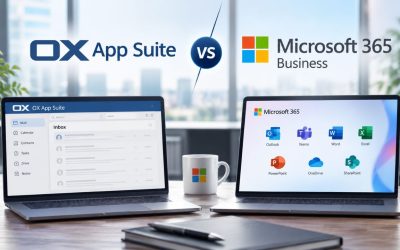
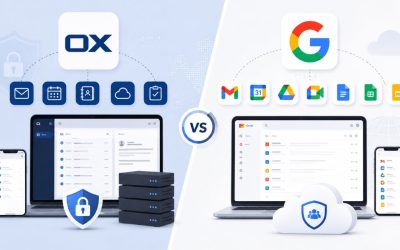
OX App Suite vs. Google Workspace vs. Microsoft 365
Businesses evaluating OX App Suite are almost always comparing it against Google Workspace and Microsoft 365, the two dominant alternatives, and the honest comparison depends heavily on which specific features and cost structure matter most to the business making the decision.
Feature and Interface Comparison
 Feature and Interface Comparison
OX Documents, OX App Suite’s browser-based office suite, sits functionally between Google Workspace’s Docs/Sheets/Slides and Microsoft 365’s web-based Office apps, closer to Google’s simplicity than Microsoft’s deeper feature set. However, OX App Suite’s differentiator is that document collaboration, mail, and calendar all live in a single unified interface rather than requiring users to bounce between separate apps, as Google Workspace’s app switcher or Microsoft 365’s app launcher do. This matters most for smaller teams without dedicated IT support, where a single consistent interface reduces the training overhead of juggling multiple app conventions.
Where Microsoft 365 pulls ahead is in desktop application depth: full Outlook, Word, and Excel with capabilities that browser-based alternatives across all providers, including OX Documents, don’t fully replicate for advanced use cases like complex macro-driven spreadsheets. Google Workspace’s strength is its search and AI-assisted features layered across Gmail and Docs, an area OX App Suite doesn’t compete on directly. Businesses whose work is genuinely browser-first and collaboration-focused rather than dependent on advanced desktop office features tend to find OX App Suite’s unified interface a reasonable middle ground between the two larger platforms’ trade-offs.
Cost and Licensing Model Differences
Google Workspace and Microsoft 365 both sell primarily through direct online self-service sign-up with published per-user pricing. At the same time, OX App Suite is distributed almost entirely through reseller partners, meaning pricing isn’t a single public rate card and instead varies by which reseller a business works with and which tiers and add-ons are selected. This isn’t inherently worse; reseller-model pricing often includes more direct support access than the self-service tiers of larger platforms, but it does mean that price comparisons require actually requesting a quote rather than checking a public pricing page, as Google Workspace and Microsoft 365 allow.
Storage allocation is another meaningful difference: OX App Suite’s domain-level pooled storage, described earlier, contrasts with Google Workspace and Microsoft 365’s more rigid per-user storage tiers in most of their standard plans, giving OX App Suite businesses more flexibility to allocate storage unevenly across a mixed team of light and heavy users without upgrading everyone’s plan tier to accommodate a handful of storage-heavy accounts.
| Comparison Point | OX App Suite | Google Workspace | Microsoft 365 |
|---|---|---|---|
| Primary purchase channel | Reseller partner | Direct self-service | Direct or reseller |
| Storage allocation model | Domain-level pooled | Per-user fixed tiers | Per-user fixed tiers |
| Built-in message encryption | OX Guard (opt-in, per message) | Client-side encryption (add-on) | Microsoft Purview (add-on) |
| Calendar sync protocol | CalDAV/CardDAV (open standard) | Proprietary + CalDAV export | Proprietary + limited CalDAV |
| Desktop office app depth | Browser-based (OX Documents) | Browser-based (Docs/Sheets) | Full desktop apps available |
| Public pricing page | No, quote-based | Yes | Yes |
| Admin permission tiers | Domain/group/user | Org unit-based | Role-based (Entra ID) |
| Mobile app offline caching | Yes, the native OX Mail app | Yes | Yes |
Frequently Asked Questions
How long does a full OX App Suite migration take for a business with 20+ mailboxes?
Beyond the ten-minute activation covered above, a 20-plus mailbox migration involving a historical mail import typically takes several days to two weeks, driven mainly by the amount of historical data to be transferred rather than the number of mailboxes. A business with 20 mailboxes averaging 2GB each moves considerably faster than one with 20 mailboxes averaging 30GB each, since IMAP-based transfer speed is bound by data volume, not headcount. Scheduling the bulk of the transfer during off-hours and reserving the actual MX cutover for a single planned window after transfer completion is confirmed keeps the visible downtime to effectively zero, regardless of how long the background data transfer itself takes.
Does OX App Suite work with Outlook, or only with its own webmail interface?
OX App Suite supports Outlook via standard IMAP/SMTP configuration and, on many reseller plans, via an EAS (Exchange ActiveSync) or MAPI-style connector, depending on the add-on tier provisioned, so users who prefer to stay in Outlook rather than switch to OX’s own web interface can generally do so. The catch is that some OX-specific features, certain nuances of shared calendar permissions, and OX Guard encryption controls are only fully accessible through the native OX App Suite interface, meaning Outlook users get core mail, calendar, and contacts but may need to log in to webmail occasionally for advanced settings.
What happens to my mailbox if I miss a renewal payment?
This depends entirely on your reseller’s grace period policy, which is why confirming it in writing before signing matters more than assuming a standard timeline applies across the industry. Ask specifically: how many days after a missed payment does the mailbox become read-only or suspended; is there an automated retry on the payment method before that happens; and is there a hard deletion date after which mail content is unrecoverable? Getting these three answers in writing from your reseller before signing avoids the far more stressful version of this question, which is asking it for the first time during an actual missed payment.
Can I use OX App Suite with a domain that already has Google Workspace mail active?
Yes, but not simultaneously receiving mail on the same domain without careful MX planning, you can run OX App Suite mailboxes on a subdomain. At the same time, Google Workspace remains on the primary domain during a transition period, which is a common approach for businesses that want to test OX App Suite with a small team before a full cutover. A full domain migration from Google Workspace requires switching MX records entirely to OX App Suite once you’re ready. At this point, Google Workspace stops receiving new mail for that domain, so the subdomain approach is specifically useful for parallel testing rather than long-term dual operation.
Is OX App Suite suitable for a solo consultant, or is it better suited to larger teams?
OX App Suite’s mailbox-level permission model and shared calendar features are genuinely more valuable at team scale. Still, a solo consultant gets full use of custom-domain email, spam filtering, and OX Drive storage without needing any of the multi-user administrative features, making single-mailbox plans a reasonably priced option even at the smallest scale. The consideration for a solo user is less about whether the platform fits and more about whether the reseller’s smallest available tier is priced competitively against single-mailbox alternatives, which is worth comparing directly since per-mailbox costs sometimes scale less favorably at the very bottom of a reseller’s pricing tiers.
How does OX App Suite handle email backups, and are they included by default?
Standard OX App Suite plans typically retain mail within the mailbox itself rather than maintaining a separate, independently restorable backup archive by default, meaning accidental permanent deletion by a user isn’t automatically recoverable unless a dedicated archiving or backup add-on has been provisioned. Businesses in regulated industries or those with compliance retention requirements should specifically ask their reseller about an archiving module, which typically stores a separate, tamper-resistant copy of mail for a defined retention period independent of what a user does within their own mailbox.
Will switching to OX App Suite break existing shared calendar invites and recurring meetings?
Recurring meeting series generally transfer correctly through standard iCalendar export/import, but meetings with complex exception patterns, a weekly meeting with several individually rescheduled occurrences, sometimes lose those specific exceptions during migration, reverting to the original unmodified recurrence pattern. Spot-checking a handful of your most complex recurring meetings after migration, before assuming a bulk calendar import captured everything perfectly, catches this early enough to manually fix the handful of affected events rather than discovering the issue when someone shows up to a meeting that’s since moved.
Does OX App Suite support custom domain email for multiple domains under one account?
Yes, OX App Suite supports multiple domains under a single reseller-managed account, with mailboxes assignable to whichever domain is relevant, which is useful for businesses operating multiple brands or those that acquired a company and want to maintain the acquired brand’s domain for email continuity. Each additional domain typically requires its own DNS verification, MX, SPF, and DKIM setup exactly as described earlier in this guide, since DNS authentication is domain-specific rather than inherited from the primary domain on the account.
How secure is OX App Suite for a business that handles clients’ financial or health information?
OX Guard’s message-level encryption addresses confidentiality for individual sensitive messages. Still, businesses in regulated industries should also confirm their specific reseller’s compliance posture, data center certifications, data residency, and whether a signed business associate agreement or equivalent is available, since these vary by reseller and underlying infrastructure arrangements rather than being fixed features of OX App Suite itself. Asking your reseller directly which compliance frameworks their infrastructure partners maintain, rather than assuming based on a platform’s general reputation, is the appropriate step before handling regulated data through any hosted email platform.
What should I actually ask a reseller before signing an OX App Suite contract?
Beyond pricing, ask for the renewal rate in writing, the specific grace period policy, whether storage is pooled or per-mailbox, which add-ons (OX Guard, archiving, extra storage) are included versus billed separately, and what the mailbox migration process looks like in terms of estimated timeline for your specific data volume. A reseller comfortable answering all of these clearly and in writing, without deflecting to a sales call for details that should be documentable, is generally a reasonable signal of how support interactions will go after you’ve signed, not just during the sales process itself.
Glossary
MX Record: A DNS record specifying which mail server accepts incoming messages for a domain, along with a priority value determining delivery order.
SPF (Sender Policy Framework): A DNS TXT record listing servers authorized to send mail for a domain, defined under RFC 7208.
DKIM (DomainKeys Identified Mail): An email authentication method using a cryptographic key pair to sign outgoing mail and verify it wasn’t altered in transit.
DMARC (Domain-based Message Authentication, Reporting & Conformance): A policy layer built on SPF and DKIM that tells receiving servers how to handle authentication failures.
IMAP (Internet Message Access Protocol): A protocol for retrieving and syncing mail across multiple devices while keeping messages stored on the server.
SMTP (Simple Mail Transfer Protocol): The protocol used to send outgoing mail between mail servers.
CalDAV / CardDAV: Open standard protocols for syncing calendar and contact data across different applications and devices.
OX Guard: OX App Suite’s built-in PGP-based encryption module for securing individual message content end-to-end.
OX Drive: OX App Suite’s file storage and sync component, provisioned per mailbox and drawing from the same storage pool.
TLS/STARTTLS: Encryption protocols that protect mail in transit between mail servers, distinct from message-level encryption like OX Guard.
The Hiya Digital Team is a collective of IT infrastructure specialist engineers, certified systems administrators, and cloud architects driven by a singular mission: building corporate communication systems that just work. As an Authorized Google Partner, the team handles complex global hosting deployments, secure email migrations, and advanced data compliance architectures for businesses across 40+ countries.
With over two decades of technical experience spanning custom premium business email configurations, OX AppSuite deployments, and enterprise-level network security, the Hiya Digital Team writes to demystify domain infrastructure. Their content focuses on actionable technical strategies, anti-phishing security protocols, and seamless cloud collaboration setup, all backed by real-world deployment experience and 24/7 technical support accountability.