Try Professional Email Powered by OX App Suite →
What OX App Suite Is and Why E-commerce Businesses Use It
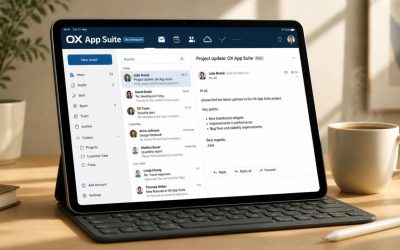
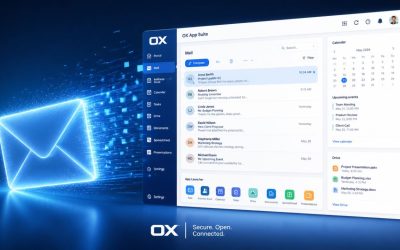
OX App Suite, developed by Open-Xchange, bundles webmail, calendaring, contacts, and file storage into a single browser-based workspace rather than a standalone mail client bolted onto a hosting account. For a store owner juggling order notifications, payment gateway alerts, and supplier correspondence, that means one login instead of five separate tools stitched together with forwarding rules.
E-commerce-Specific Email Demands
Order confirmation and shipping notification volume creates a pattern that most general-purpose inboxes aren’t built around: dozens or hundreds of near-identical transactional emails competing for attention with the handful of messages that actually need a human reply. A single shared inbox strategy works for a five-order-a-week store. Still, once transactional volume climbs, teams need filtering, tagging, and delegation that go beyond what a personal email plan typically supports. OX App Suite’s mail rules and folder sharing let a team route transactional noise into a single view while keeping customer replies, chargebacks, and supplier negotiations visible to the right person.
Seasonal spikes add a second demand that’s easy to underestimate during initial setup. A store that handles 200 orders a week in March can see that number quadruple during a November sale event, and mailbox performance under that load depends on server-side filtering rather than client-side rules that only run when a device is open. Because OX App Suite processes filters on the server, a rule sorting “[email protected]” messages into a subfolder keeps working whether or not anyone has a browser tab open, which matters when a founder is manually restocking inventory at 11 PM during a flash sale and can’t also be triaging email.
Common Objections from Store Owners
Migration risk is usually the first concern raised, and it’s a reasonable one; a botched cutover during a sales period can mean missed orders. As covered under DNS Maintenance, propagation timing is the main variable, and reputable providers stage the switch to avoid a mail-loss window. The second common objection is DNS complexity itself; many store owners have never touched an MX or TXT record and assume it requires a developer. In practice, a provider handling the account typically supplies the exact record values needed, and the store owner’s role is limited to pasting them into whatever registrar or DNS host they already use for their storefront domain.
Cost-per-mailbox is the third recurring objection, particularly from stores comparing OX App Suite against a free webmail forward or a single Google Workspace seat. The honest answer is that free forwarding services don’t offer authenticated sending from a custom domain, which increasingly affects deliverability as major inbox providers tighten filtering on unauthenticated senders. A store weighing five mailboxes against a single shared inbox should think in terms of which support and fulfillment roles genuinely need separate accountability; a returns mailbox with its own login and audit trail behaves differently than a shared password five people know, especially once refund approvals are involved.
Mailbox Provisioning and Custom Domain Configuration
Setting up OX App Suite for a store starts with attaching the storefront’s existing domain to a set of mailboxes rather than replacing the domain itself. The process cleanly separates into domain verification, mailbox creation, and permission assignment, each of which affects how the team actually uses the inboxes day-to-day.
 Domain Verification and Mailbox Creation
 Domain Verification and Mailbox Creation
Before any mailbox goes live, the domain must be verified as owned by the account holder, typically via a DNS TXT record that proves control without affecting existing website traffic. This step runs independently of the storefront’s web hosting, so a store built on Shopify, WooCommerce, or a custom cart doesn’t need to touch its website configuration to add business email; the domain gains a second, unrelated set of DNS entries dedicated to mail. Once verification completes, mailbox creation is handled through an admin panel, where each address (orders@, returns@, support@) is created as its own account with its own credentials, rather than as an alias forwarding to a single inbox.
The distinction between an alias and a full mailbox matters more for growing stores than it initially seems. An alias redirects incoming mail to an existing inbox, which is fine for a single founder but breaks down the moment two people need to work the same queue independently. Replies sent from an alias typically show the underlying account’s address, not the alias’s, which confuses customers who reply to “returns@” and receive a response from “founder@.” Full mailboxes avoid this because each one sends and receives under its own identity, with its own inbox, sent folder, and login, which is the setup most stores need once they have even one part-time support hire.
Mailbox-Level Permission Structures
OX App Suite assigns permissions at the individual mailbox and folder level rather than granting all-or-nothing account access, which lets an admin give a fulfillment contractor visibility into the orders inbox without exposing supplier pricing negotiations sitting in a separate folder. This permission model is set per user per resource, a specific mailbox, calendar, or Drive folder, so a seasonal hire brought on for a holiday rush can be scoped to exactly the inboxes and calendars relevant to their role, then have that access revoked cleanly when the contract ends, without deleting or resetting the mailbox itself.
For stores with outsourced customer support or a virtual assistant handling order inquiries, this permission granularity replaces the common workaround of sharing a single password in a spreadsheet, which lacks an audit trail and has no way to revoke one person’s access without changing it for everyone. An admin can grant read-and-reply access to the support mailbox while withholding delete permissions, so a new hire can’t accidentally clear a queue of unread customer messages during their first week. The mailbox-level permission structure also serves as the foundation for how shared calendars and Drive folders are scoped later, as addressed in the collaboration section further down this page.
DNS Records Required for OX App Suite Email Delivery
Correct DNS configuration determines whether messages sent from a store’s domain land in a customer’s inbox or get filtered as suspicious. Four record types do the actual authentication work, and getting any one of them wrong tends to show up as delivery problems days after the change, not immediately.
MX and SPF Records
The MX (Mail Exchanger) record tells the sending server where to deliver incoming mail for the domain, directing it to OX App Suite’s mail servers rather than wherever the domain was previously routed. Store owners moving from a hosting-bundled email plan need to replace the old MX entries entirely rather than adding new ones alongside them, since multiple active MX records with different priorities can cause mail to split between two systems, with some messages landing in the old, now-unmonitored inbox.
SPF, defined by the IETF’s RFC 7208 , Sender Policy Framework (SPF) for Authorizing Use of Domains in Email, works as a DNS TXT record listing which servers are allowed to send mail on the domain’s behalf. Receiving servers check this record against the sending server’s IP address, and a mismatch is one of the more common reasons legitimate order-confirmation emails end up in spam folders. A detail that trips up stores using multiple platforms, their storefront’s transactional email service, a marketing tool, and OX App Suite mailboxes all sending from the same domain, is that SPF caps out at 10 DNS lookups per check under the RFC’s specification. Each third-party service included in the record typically consumes one or more of those lookups. A store that layers on a shopping cart’s email service, an SMS-and-email marketing platform, and a helpdesk tool alongside OX App Suite mailboxes can exceed that ceiling without anyone noticing until deliverability quietly drops, since a lookup overflow returns a permanent error rather than a warning.
DKIM and DMARC Configuration
DKIM (DomainKeys Identified Mail) attaches a cryptographic signature to outgoing messages, generated from a private key held by the sending server and verified against a public key published in a DNS TXT record. Unlike SPF, which authorizes servers by IP address, DKIM verifies that message content hasn’t been altered in transit, and OX App Suite provisions this signing per domain, meaning each domain attached to the account gets its own key pair rather than sharing one signature across every customer on shared infrastructure, which keeps one domain’s sending reputation from being dragged down by another domain’s poor practices.
DMARC (Domain-based Message Authentication, Reporting, and Conformance) sits on top of both SPF and DKIM, telling receiving servers what to do when a message fails those checks: quarantine it, reject it outright, or monitor and report. A DMARC record set to a monitoring-only policy is the safer starting point for a store during its first weeks on OX App Suite, since it surfaces authentication failures through aggregate reports without risking legitimate mail getting rejected while SPF and DKIM are still settling in. Store owners who skip straight to a strict “reject” policy before confirming every sending source (the storefront platform, any marketing tool, and the mailbox provider) is properly authenticated risk losing real customer-facing email, including order confirmations sent through a third-party checkout service that hasn’t been added to the SPF record yet.
Security Architecture: Spam Filtering, Anti-Virus, and OX Guard Encryption
E-commerce inboxes are a frequent phishing target precisely because customers expect order-related emails with links and attachments, which lowers their guard against malicious lookalikes. OX App Suite layers filtering, scanning, and optional encryption to reduce that exposure without requiring end users to change how they work.
Spam and Anti-Virus Filtering
 Spam and Anti-Virus Filtering
Incoming mail passes through SpamExpert-style filtering before it reaches a mailbox, scoring messages against known spam patterns, sender reputation, and content heuristics rather than relying on a single blocklist. For a store, this filtering layer is what keeps a returns mailbox from being buried under promotional spam and fraudulent “unclaimed package” phishing attempts that specifically target online shoppers, since those messages are crafted to look like the legitimate shipping and order notifications a customer-facing inbox genuinely expects.
Anti-virus scanning runs against attachments and embedded links separately from spam scoring, catching malicious files sent as fake invoices or supplier documents, a common attack vector against businesses that regularly receive PDFs and spreadsheets from external parties they don’t personally know. A store’s wholesale or supplier-facing mailbox is a higher-risk target for this than its general support inbox, since attackers impersonating a supplier with a modified invoice can attempt to redirect a real payment to a fraudulent account, and catching a malicious attachment before it opens is meaningfully cheaper than recovering from a fraudulent wire transfer after the fact.
OX Guard Encryption
OX Guard is OX App Suite’s built-in encryption add-on, using PGP-standard encryption to let users send an encrypted email with a single click, rather than requiring the manual key management most PGP tools demand. For e-commerce specifically, this matters when a mailbox handles anything beyond routine order confirmations, a customer disputing a charge might need to share partial card details for verification, or a supplier contract negotiation might include pricing terms neither party wants sitting in plaintext on a mail server indefinitely.
Renewal reviews often reveal a stale SPF, with no one remembering adding it via a marketing tool the store stopped using months earlier. OX Guard doesn’t touch that particular problem. Encryption protects message content in transit and at rest, not sender authentication, so the two need to be treated as separate maintenance items rather than substitutes for each other. OX Guard can be enabled selectively per mailbox rather than suite-wide, which is the practical approach for most stores: a general orders@ inbox handling routine transactional mail rarely needs encryption overhead, while a finance@ or legal-facing mailbox handling sensitive supplier or dispute correspondence benefits from it being on by default. Reference: Open-Xchange OX Guard technical documentation.
Collaboration Features for E-commerce Teams
Order fulfillment rarely lives in email alone. Shared calendars, contact lists, and document collaboration within OX App Suite enable a small team to coordinate restocking, returns, and supplier relationships without exporting data to a separate project tool.
Shared Calendars and Contacts
A shared fulfillment calendar lets a team track restock dates, supplier delivery windows, and promotional launch dates in one place visible to everyone who needs it, without each person maintaining a personal calendar and manually cross-checking dates before committing to a sale. OX App Suite calendars sync using the CalDAV protocol, an open standard that lets the same calendar appear correctly in a phone’s native calendar app, a desktop client, and the OX web interface simultaneously, rather than requiring everyone to check a specific browser tab. For a founder managing inventory from a warehouse floor, having restock dates appear in their phone’s default calendar app without extra setup is a meaningful practical difference from a tool that only works inside its own dedicated app.
Shared contacts sync through the related CardDAV protocol, keeping a supplier or wholesale customer list consistent across every team member’s device rather than living in one person’s personal address book. This becomes a real operational risk when it’s absent. A store where only the founder has a supplier’s direct contact saved creates a single point of failure if that person is unavailable during a supply issue. In contrast, a shared contact folder means anyone on the team can pull up the right phone number during a shipping delay without waiting on a reply from someone who might be offline.
Document Collaboration and File Sharing
OX Drive gives the team shared storage for documents that don’t belong in an email thread, supplier agreements, return-policy templates, or product photography assets that multiple people need to access and update. Rather than emailing a spreadsheet back and forth as new versions accumulate confusing filenames, a shared Drive folder keeps one authoritative version with edit history, which matters for something like a running inventory reconciliation sheet that several people touch throughout a week.
Permission separation on shared calendars and Drive folders works the same way mailbox permissions do: scoped per person and per resource, so a seasonal contractor can be given edit access to a specific returns-tracking document without also seeing the supplier-pricing folder in the same Drive account. This separation is what allows a growing store to bring on temporary help during peak season without a blanket choice between full access and no access at all, which is the binary most small teams default to when they haven’t set up permission boundaries deliberately.
Talk to an Authorized OX App Suite Partner About Your Store’s Setup
Getting mailbox permissions, shared calendars, and Drive folders configured correctly from the start avoids the scramble of untangling access mid-season once a returns queue or supplier folder has already been shared too broadly. Hiya Digital, as an Authorized Partner and Reseller of the OX App Suite Email Service, can help scope a setup based on how your store’s team actually works.

Storage Capacity and Scaling for Order-Heavy Mailboxes
Transactional email volume accumulates faster than most owners expect once a store passes a few hundred orders a month, and storage limits that felt generous at launch can fill up within a single busy season if archiving isn’t part of the plan.
Storage Allocation and Pooling
OX App Suite plans allocate storage per mailbox, but administrators can pool unused capacity across a domain’s mailboxes rather than treating each one as a hard, isolated ceiling. A store’s returns mailbox might barely touch its allocation in a slow month while the general orders inbox, loaded with attachment-heavy shipping labels and customer photos of damaged items, runs closer to its limit, pooling lets that headroom shift where it’s actually needed instead of forcing an upgrade on every mailbox to fix a tight one.
This pooling extends to OX Drive storage as well, so shared document folders and individual mailboxes draw from a combined domain-level allowance rather than fully separate buckets. Attachment size limits matter more for e-commerce than for typical business correspondence, since customer support threads frequently include photos of damaged products, screenshots of order confirmations, or scanned return labels. A mailbox that rejects a customer’s damage photo because it exceeds an attachment ceiling creates friction at exactly the moment a store needs frictionless communication to resolve a complaint before it becomes a public review or a chargeback dispute.
Archiving and Retention for High-Volume Inboxes
A general orders@ mailbox handling automated transactional email benefits from an archiving policy that automatically moves messages older than a set window into cold storage, keeping the active inbox fast and searchable rather than bogged down by years of routine shipping confirmations that nobody will ever open again. This matters practically because search performance and client sync speed both degrade as an inbox grows into tens of thousands of messages, and most of that volume in an e-commerce context is transactional noise rather than anything requiring quick retrieval.
Retention needs differ meaningfully by mailbox type within the same store, which is a detail worth planning for rather than applying one blanket policy everywhere. A finance-facing mailbox handling invoice disputes or chargebacks often needs longer retention to support a dispute filed months after the original transaction, while a general support inbox handling routine “where is my order” questions has little reason to retain messages that long once the ticket closes. Setting retention per mailbox rather than domain-wide avoids both over-retaining low-value transactional clutter and under-retaining the records that a chargeback dispute might actually require.
Mobile and Desktop Client Compatibility
A store owner checking orders from a phone between warehouse tasks needs the same functional inbox they’d get at a desk, and compatibility gaps between platforms are usually where that expectation breaks down.
Native App and Webmail Access
 Native App and Webmail Access
OX App Suite’s own mobile app connects directly to mail, calendar, and contacts using the suite’s native sync protocols, giving full access to shared folders and permission-scoped resources exactly as configured on the desktop. This differs from connecting the same account through a phone’s built-in mail app using generic IMAP settings, which retrieves mail correctly but doesn’t always expose OX-specific features like shared folder permissions or Drive integration the same way the dedicated app does, a distinction worth knowing before assuming “any mail app will work the same”.
For a store owner who prefers using their phone’s default mail app rather than installing another dedicated app, OX App Suite supports standard IMAP and POP3 access, along with SMTP for sending, so existing habits built around Apple Mail, Gmail’s app, or Outlook Mobile don’t need to change. The trade-off is that IMAP-based access syncs mail and folder structure but doesn’t carry over calendar-sharing permissions or Drive links the way the native client does, so a team relying heavily on shared calendars for fulfillment scheduling gets more consistent behavior from the dedicated app or a CalDAV-aware calendar app than from IMAP alone.
Desktop Client and Outlook Integration
Desktop access works through the OX web interface directly in a browser, which requires no local installation and stays current without update management, a genuine advantage for a small team without dedicated IT support handling client software updates across several computers. For businesses standardized on Microsoft Outlook as their desktop client, OX App Suite supports Outlook connectivity via IMAP/SMTP configuration, allowing mail to flow into an existing Outlook setup. At the same time, calendar and contact sync typically routes through CalDAV/CardDAV-compatible plugins rather than Outlook’s native Exchange protocol.
This Outlook compatibility path matters for stores migrating from a Microsoft-centric setup and that do not want to retrain staff on an entirely new interface. The practical limitation worth setting expectations around is that some deep Outlook-specific features tied to Microsoft’s proprietary Exchange protocol won’t carry over one-to-one through an IMAP connection, so a team with heavy dependence on Outlook-specific calendar delegation or shared mailbox behaviors should test their specific workflow during a trial period before fully committing, rather than assuming feature parity by default.
Migrating an E-commerce Store’s Email to OX App Suite
Moving an active store’s email without dropping orders during the transition is the single biggest concern most owners raise before switching providers, and the concern is legitimate; a poorly timed cutover can mean genuinely lost customer messages during a live sales window.
Pre-Migration Planning
The first practical step is exporting existing mail from the current provider in a standard format, typically via IMAP migration tools that copy message content, folder structure, and read/unread status rather than requiring a manual forward of every important thread. Before touching DNS, every mailbox that needs to exist in OX App Suite should be provisioned and verified as working in isolation, so the only remaining step on cutover day is the DNS change itself, rather than troubleshooting mailbox creation issues while mail is actively in flight between the two systems.
Legacy document formats sitting in old email attachments, proposal templates, product spec sheets, or supplier catalogs saved as older Office file types often need conversion during migration to work cleanly inside OX Drive’s collaborative editing environment. OX Documents handles this conversion natively when files are moved into Drive, preserving formatting for the vast majority of standard business documents. However, heavily formatted spreadsheets with complex macros are the more common exception and are worth spot-checking after migration rather than assuming a perfect one-to-one conversion.
Cutover Timing and Mail-Loss Prevention
DNS changes don’t take effect instantly across the internet; propagation can take anywhere from a few minutes to 48 hours, depending on the record’s time-to-live setting and how aggressively various DNS resolvers cache old values. As covered under DNS Maintenance, mismatched MX records during this window are the primary cause of dropped mail, since some senders’ servers will still route to the old mail host until their cached record expires. In contrast, others pick up the new destination immediately.
The safer cutover pattern for a live store is to lower the DNS record’s time-to-live several days before the actual switch, which shortens how long old cached values persist once the real change is made, and then schedule the cutover itself for a low-order-volume window rather than mid-promotion. Keeping the old mailbox active and forwarding to the new one for a short overlap period after cutover, rather than deleting it immediately, catches any messages still routed by resolvers that haven’t yet picked up the new MX record, which is a low-effort safeguard against the exact mail-loss scenario store owners worry about most.
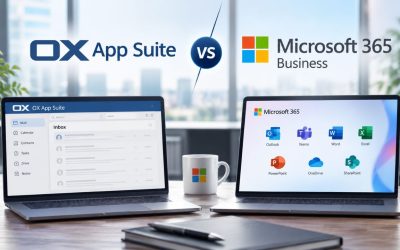
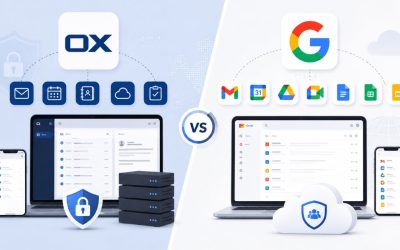
OX App Suite Compared to Google Workspace and Microsoft 365
Store owners evaluating email providers usually have Google Workspace or Microsoft 365 as reference points, since those are the platforms most commonly recommended by default. The real differences show up less in raw features and more in how permissions, storage, and licensing are structured.
Feature and Permission Differences
While Google Workspace and Microsoft 365 both offer shared calendars, their permission models differ from OX App Suite’s approach in ways that matter to a store managing contractors and seasonal staff. OX App Suite separates calendar-sharing permissions distinctly from mailbox permissions at a granular, per-resource level, so a contractor can get read-only visibility into a fulfillment calendar without that access implying anything about mailbox or Drive folder access. The three permission types don’t inherit from one another by default, unlike some competing platforms that bundle them under a single sharing toggle.
The pricing structure is the other major point of divergence, rather than any single missing feature. Google Workspace and Microsoft 365 are typically sold directly per seat at published list pricing with limited room for a reseller to adjust terms. In contrast, OX App Suite is commonly distributed through authorized reseller partners, which can mean more flexibility in mailbox count, storage tiers, and support arrangement tailored to a smaller store’s actual needs rather than a one-size-fits-all seat license built around enterprise assumptions.
When Each Platform Makes Sense
A store already deeply embedded in Google’s ecosystem, using Google Ads, Google Analytics, and Google Sheets daily, may find that staying within Google Workspace reduces friction simply through familiarity and existing tool integration, even if OX App Suite’s permission model is arguably better suited to a small team’s actual access-control needs.
Similarly, a store running on Microsoft’s broader business suite for accounting or inventory software with deep Office 365 integration has a reasonable case for staying within that ecosystem rather than introducing a second vendor relationship. OX App Suite tends to make the strongest case for a store that wants dedicated reseller support, relationship-based rather than ticket-queue support, values the more granular permission separation described above, or is specifically trying to avoid being locked into a single vendor’s broader ecosystem, with pricing increasing over time. None of these platforms is categorically better in every scenario, and a decision genuinely based on how a store’s team actually works day-to-day tends to hold up better than one made purely on brand familiarity.
| Comparison Point | OX App Suite | Google Workspace | Microsoft 365 |
|---|---|---|---|
| Calendar/mailbox permission inheritance | Independent per resource, no automatic inheritance | Partially linked via Google Groups sharing | Linked via Exchange delegate permissions |
| Native encryption add-on | OX Guard (PGP/S-MIME, per-mailbox toggle) | Client-side encryption (admin-enabled, limited tiers) | Microsoft Purview Message Encryption (tier-dependent) |
| Primary distribution channel | Authorized reseller partners | Direct or reseller | Direct or Cloud Solution Provider (CSP) partner |
| Native document co-editing | OX Documents | Google Docs/Sheets | Word/Excel Online |
| Calendar sync protocol | CalDAV (open standard) | CalDAV is supported alongside the proprietary API | Exchange ActiveSync/proprietary primary path |
| Mobile access | Dedicated app + standard IMAP/POP3 | Dedicated app + standard IMAP | Outlook app + Exchange ActiveSync |
| Storage pooling across mailboxes | Supported at the domain level | Pooled storage on Business Standard+ | Pooled storage on select plans |
| Typical target business size | SMB to mid-market via reseller-tailored plans | SMB to enterprise | SMB to enterprise |
| Contract flexibility | Reseller-negotiated terms | Largely fixed published tiers | Largely fixed published tiers, CSP variance possible |
| Support model | Reseller-managed relationship support | Google-direct ticket/community support | Microsoft-direct or CSP-managed support |
Pricing Structure, Renewal Terms, and Licensing Through a Reseller
Understanding how OX App Suite is priced and licensed when purchased through a reseller like Hiya Digital helps avoid renewal surprises that catch many small businesses off guard after their first contract year.
Introductory Pricing and Renewal Variability
 Introductory Pricing and Renewal Variability
Introductory pricing for hosted email services, OX App Suite included, is commonly lower than the renewal rate applied in subsequent contract terms, a pattern common across the hosting industry rather than specific to any one provider. Because Hiya Digital operates as an Authorized Partner and Reseller rather than the underlying infrastructure owner, exact renewal pricing and any grace-period terms depend on the specific plan and term length agreed with the reseller at signup, approximate ranges can be discussed during a consultation, but published fixed prices for e-commerce mailbox bundles vary enough by mailbox count and storage tier that a general figure quoted without those specifics wouldn’t be a reliable planning number.
Store owners are better served by asking their reseller directly, in writing, what the renewal rate will be before the introductory term ends, rather than assuming the first invoice sets the ongoing rate. Add-on costs are another area where a store’s actual bill diverges from the advertised base price, since OX Guard encryption, expanded storage tiers, and additional mailboxes beyond a plan’s included count are frequently priced separately from the base mailbox license. A store budgeting for OX App Suite should request an itemized quote that covers the specific mailbox count, storage tier, and any add-ons, such as encryption, needed for a finance-facing inbox, rather than budgeting based on a generic starting price that may not reflect the store’s actual configuration.
Reseller-Managed Licensing Model
Because OX App Suite is licensed through the underlying Open-Xchange infrastructure but sold and supported through authorized partners, a store’s day-to-day billing and support relationship runs through the reseller rather than directly with Open-Xchange itself. This reseller-managed structure is the reason Hiya Digital is accurately described as an Authorized Partner and Business Email Solution Provider rather than as the platform’s developer or infrastructure owner, the distinction matters practically because support requests, plan changes, and renewal negotiations are handled through the reseller relationship, which for many small stores means more direct, relationship-based communication than filing a ticket into a large platform’s general support queue.
Licensing terms, including how many mailboxes are included in a base plan versus billed as add-ons, and what happens if a store needs to add or remove mailboxes mid-term, are set by the specific reseller agreement rather than a single universal OX App Suite price sheet. A store expecting seasonal mailbox needs, adding temporary support inboxes for a holiday rush, for instance, should raise that expectation during the initial sales conversation, since mid-term flexibility on mailbox count is a reseller-negotiated term rather than a guaranteed default across every plan.
Setup Mistakes and Troubleshooting Basics
Most OX App Suite problems e-commerce teams encounter trace back to a handful of recurring setup mistakes rather than platform defects, and most are avoidable with an understanding of the DNS and permission concepts covered earlier on this page.
Recurring Configuration Mistakes
Leaving a previous provider’s MX records active alongside the new ones, rather than fully replacing them, is the single most common mistake during migration and causes mail to split unpredictably between old and new systems. A close second is publishing an SPF record that references the previous provider’s servers but never gets updated when switching to OX App Suite, which can cause legitimate outgoing mail to fail authentication checks at receiving servers even though the mailbox itself is functioning normally on the new platform.
Over-broad permission grants during initial setup, giving a new hire full mailbox access instead of scoping it to exactly the folders and calendars their role needs, tend to surface as a problem months later rather than immediately, typically when someone notices a former contractor’s access was never revoked, or a seasonal hire could see supplier pricing they had no reason to view. Building the habit of scoping permissions narrowly from the first mailbox setup, rather than granting broad access “to save time” with the intention of tightening it later, avoids most of these situations before they happen.
Basic Troubleshooting Steps
When outgoing mail isn’t reaching customers, checking SPF and DKIM alignment via a DNS lookup tool is the fastest first step, since a failed authentication check is a more common culprit than a false positive from a spam filter. If incoming mail seems delayed or missing, confirming the MX record still points correctly to OX App Suite’s servers, rather than a stale entry left over from a previous provider, rules out the most common cause before escalating to a support ticket.
For mobile sync issues specifically, re-verifying whether the account was set up through the dedicated OX App Suite app versus generic IMAP settings on the phone’s native mail app often resolves calendar or shared-folder visibility problems, since those are the features most likely to behave differently between the two connection methods discussed earlier on this page. Persistent issues beyond these basic checks are typically resolved faster through a reseller’s support relationship than through general troubleshooting, since a reseller can see the specific account configuration rather than relying solely on platform documentation.
Frequently Asked Questions
How much does OX App Suite cost for a small e-commerce store?
Exact pricing depends on mailbox count, storage tier, and any add-ons, such as OX Guard encryption. Because Hiya Digital sells OX App Suite as an Authorized Reseller rather than the infrastructure owner, published fixed prices aren’t reliable planning figures; actual quotes vary by term length and configuration. A useful budgeting benchmark is to request pricing for your specific mailbox count (say, four to six addresses covering orders, returns, support, and wholesale) rather than a generic single-seat price, since bundled small-business pricing rarely scales linearly with mailbox count. Ask specifically whether quoted pricing is introductory or the ongoing renewal rate, and request that distinction in writing before signing.
What should I ask my reseller before signing an OX App Suite contract?
Beyond the base price, ask for the exact renewal rate that applies after any introductory period ends; whether there’s a grace period if a renewal payment is missed and what happens to mailbox access during that period; and whether the mailbox count can be adjusted mid-term for seasonal needs without penalty. Also confirm what’s included in support, response time expectations, whether the reseller handles DNS changes or requires the store owner to make them, and whether migration assistance from a previous provider is included in the setup cost or billed separately. Getting these specifics in writing before signing helps avoid the most common source of dissatisfaction with hosted email contracts.
Can I migrate my existing Shopify or WooCommerce order emails into OX App Suite?
Transactional emails sent automatically by Shopify, WooCommerce, or similar cart platforms aren’t typically stored in a mailbox the way personal correspondence is; they’re usually sent from the platform’s own transactional email service and logged in the platform’s admin panel, not in an inbox that needs migrating. What needs migrating is any historical correspondence sitting in your current business mailbox, customer support threads, supplier emails, and internal notes, which are transferred via standard IMAP migration tools during the cutover process described earlier on this page. Your storefront platform’s transactional sending configuration is a separate setting updated independently of the mailbox migration itself.
Does OX App Suite support Outlook for Teams already in use?
Yes, through IMAP/SMTP configuration for mail sending and receiving, though calendar and contact sync typically route through CalDAV/CardDAV-compatible connectors rather than Outlook’s native Exchange protocol. Teams with light Outlook usage, checking mail, replying, and basic calendar entries generally see no functional difference. Teams relying on Outlook-specific features, such as complex delegate permissions or Exchange-based shared mailbox behaviors, should test their workflows during a trial period, since those features don’t map one-to-one to a standard IMAP connection and may require adjustments.
How does OX App Suite handle mobile access for a team checking orders on the go?
The dedicated OX App Suite mobile app connects using the suite’s native protocols, preserving shared folder permissions and calendar sharing exactly as configured on desktop. Alternatively, standard IMAP/POP3 and SMTP settings work with a phone’s built-in mail app, which is a fine option for basic mail access but doesn’t carry over Drive links or shared calendar permissions with the same fidelity as the dedicated app. For a team relying heavily on a shared fulfillment calendar viewed from personal phones, testing both access methods during setup, rather than assuming they behave identically, avoids confusion once the team is actively relying on it during a busy period.
Is my customer data secure with OX App Suite, and does it support any compliance requirements?
OX App Suite’s security stack includes spam and anti-virus filtering at the server level before mail reaches a mailbox, plus optional OX Guard encryption for messages and files that need it, such as those containing partial payment details during a dispute. For stores handling EU customer data, GDPR considerations regarding data storage location and processing agreements are worth raising directly with your reseller, since specific compliance documentation and data residency options depend on the hosting configuration associated with your plan rather than being uniform across all OX App Suite deployments.
What happens to my email if I miss a renewal payment?
Grace period policies, how long a mailbox stays active after a missed payment before access is suspended, and what happens to stored mail during that window are set by the specific reseller agreement rather than a universal OX App Suite policy, which is why confirming this in writing before signing (as raised in an earlier FAQ) matters. In general, hosted email providers apply a short grace period before suspending access rather than an immediate cutoff. Still, the store owner should never assume a specific number of days without confirming it directly, since an incorrect assumption during a renewal lapse can result in an unexpected mailbox suspension during an active sales period.
Can I use OX App Suite with a domain I bought through a third-party registrar?
Yes, OX App Suite mailbox setup is independent of where a domain is registered, since the process only requires adding specific DNS records (MX, SPF, DKIM, and a domain verification TXT record) to whatever DNS management panel the registrar provides, whether that’s GoDaddy, Namecheap, Cloudflare, or another registrar entirely. The store’s website hosting and mail DNS records are managed separately, so switching email providers doesn’t require moving the domain registration or altering the DNS records that point to the actual storefront.
Does OX App Suite support backups, and how do I recover an accidentally deleted email?
Standard OX App Suite plans include server-side retention that typically allows recovery of recently deleted mail from a trash or recovery folder for a limited window before permanent deletion. However, the exact retention period is plan-dependent and is best confirmed directly with your reseller rather than assuming a universal figure. For business-critical correspondence, such as a signed supplier contract or a resolved chargeback dispute thread, a store shouldn’t rely solely on the mailbox’s built-in recovery window as its backup strategy; periodically exporting critical threads to OX Drive or a separate archive adds a second layer of protection beyond the mailbox’s retention settings.
How many mailboxes does a typical small e-commerce store actually need to start?
There’s no universal number, but a store moving beyond a single founder-run inbox commonly starts with three to five addresses: a general orders or info mailbox, a dedicated returns/support mailbox, a supplier or wholesale-facing address, and sometimes a separate finance-facing mailbox once chargeback or dispute volume justifies isolating it with its own access controls and, potentially, OX Guard encryption enabled. Starting with too few mailboxes and sharing one login across a growing team tends to create the exact permission and accountability problems described in the setup mistakes section above, so it’s worth provisioning slightly ahead of the current team size rather than exactly to it.
Glossary
MX Record: A DNS entry that directs incoming mail for a domain to the correct mail server.
SPF (Sender Policy Framework): A DNS TXT record listing which servers are authorized to send mail for a domain, defined under RFC 7208.
DKIM (DomainKeys Identified Mail): A cryptographic signature attached to outgoing mail, verified against a public key in DNS, confirming message content wasn’t altered in transit.
DMARC (Domain-based Message Authentication, Reporting, and Conformance): A policy layer built on SPF and DKIM that tells receiving servers how to handle messages that fail authentication.
IMAP (Internet Message Access Protocol): A protocol for retrieving and syncing mail across multiple devices while keeping messages stored on the server.
POP3 (Post Office Protocol 3): An older mail retrieval protocol that typically downloads messages to a single device rather than syncing across several.
SMTP (Simple Mail Transfer Protocol): The protocol used for sending outgoing email between servers.
CalDAV/CardDAV: Open standards for syncing calendars and contacts, respectively, across multiple devices and applications.
OX Guard: OX App Suite’s built-in PGP-based encryption add-on for securing email and file content.
OX Drive: OX App Suite’s file storage and document collaboration module.
TLS (Transport Layer Security): Encryption protocol securing data in transit between mail servers.
The Hiya Digital Team is a collective of IT infrastructure specialist engineers, certified systems administrators, and cloud architects driven by a singular mission: building corporate communication systems that just work. As an Authorized Google Partner, the team handles complex global hosting deployments, secure email migrations, and advanced data compliance architectures for businesses across 40+ countries.
With over two decades of technical experience spanning custom premium business email configurations, OX AppSuite deployments, and enterprise-level network security, the Hiya Digital Team writes to demystify domain infrastructure. Their content focuses on actionable technical strategies, anti-phishing security protocols, and seamless cloud collaboration setup, all backed by real-world deployment experience and 24/7 technical support accountability.