
Get Professional Email Powered by OX App Suite →
Why Dedicated Business Email Matters for E-commerce Brands
A store running fulfillment on a free Gmail or Yahoo address is one flagged message away from a customer thinking the order confirmation is a scam. Custom-domain email, [email protected] instead of [email protected], signals legitimacy at checkout, in abandoned-cart emails, and in every support thread a buyer opens. It also gives the owner actual administrative control over who can access what, rather than sharing a single login among five staff members.
 Trust Signals at Checkout and in Order Confirmations
 Trust Signals at Checkout and in Order Confirmations
Buyers hesitate at unfamiliar checkout pages, and a mismatched sender domain is one of the fastest ways to trigger that hesitation. When the “from” address on a shipping notification matches the store’s own domain, mail clients display it cleanly, spam filters trust it more readily, and customers recognize it in a crowded inbox. Payment processors and cart platforms increasingly flag stores that use free consumer email addresses as higher risk during merchant review, which can slow account approval or trigger manual verification.
OX App Suite assigns each staff account its own mailbox under a role-based permission model rather than one shared inbox login. A support rep can be granted access to the orders@ mailbox without ever seeing the finance@ or admin@ accounts, and that access can be revoked the moment someone leaves the team. This is a meaningfully different setup from a free email account shared via a spreadsheet password, where revoking access after a staff departure usually means resetting the password for everyone.
Separating Roles: Orders, Support, Returns, and Admin
A single-founder store often starts with one inbox handling orders, support tickets, supplier invoices, and marketing replies at once, a setup that scales poorly the moment order volume increases. Splitting these into dedicated addresses (orders@, support@, returns@, billing@) lets a growing team assign clear ownership and lets automation tools filter and route messages without a human sorting them first.
Under OX App Suite’s admin panel, a reseller-provisioned account can create these mailboxes individually and assign granular permissions, full access, send-as, or read-only, to each staff member per mailbox. A returns coordinator might get full access to returns@ and send-as rights on support@, while a bookkeeper only sees billing@. This separation also makes audit trails cleaner: if a policy dispute arises over a refund promise made by email, the relevant mailbox’s history is isolated rather than buried in a shared inbox with thousands of unrelated threads.
Core OX App Suite Tools Built Into an Online Store’s Workflow
Beyond the inbox, OX App Suite includes calendar, contacts, and cloud file storage in the same login a store’s team already uses for email. For a lean e-commerce operation, that removes the need to stitch together three separate subscriptions to share a supplier contact list or a product photo folder.
Cloud File Sync for Product Assets and Supplier Documents
Product photography, packaging artwork, and supplier price sheets pile up fast, and emailing large files back and forth between a designer and a store owner wastes both time and mailbox storage. OX Drive, the platform’s built-in cloud storage component, synchronizes files across desktop, mobile, and the webmail interface, with automatic versioning so an overwritten product image can be rolled back rather than re-requested from a supplier.
A practical use case: a store maintains a shared OX Drive folder per supplier, containing current price lists, product spec sheets, and compliance certificates. When a supplier updates a document, the change syncs to everyone with folder access, rather than triggering a new email thread with an attachment that nobody’s sure is the latest version. Drag-and-drop uploads and folder-level sharing links also mean a photographer can hand off a shoot without needing an OX account of their own; a share link with an expiration date handles that instead.
Contacts and Address Books Shared Across a Fulfillment Team
A fulfillment team juggling suppliers, freight forwarders, and wholesale customers benefits from one shared contact list rather than five personal address books that drift out of sync. OX App Suite’s global address book lets an admin publish supplier and partner contacts to the whole team, while individual staff keep private contacts for their own use.
This matters most during a supplier change or a shipping carrier switch, when outdated contact details cause real fulfillment delays. A centrally managed contact entry updates everywhere at once, rather than requiring each staff member to edit their own copy manually. For a store running seasonal hiring, extra support staff during a holiday rush, for instance, provisioning a new hire with the full supplier and carrier contact list on day one, rather than day ten, shortens the ramp-up period noticeably.
Blocking Spam, Phishing, and Fake Order Emails
E-commerce inboxes are a favorite phishing target because attackers can impersonate a payment processor, a shipping carrier, or a customer disputing a charge, and a single successful click can expose customer data or trigger a fraudulent refund. Filtering has to be aggressive enough to catch that traffic without silently dropping a legitimate customer complaint.
Anti-Spam and Anti-Virus Filtering at the Mail Gateway
 Anti-Spam and Anti-Virus Filtering at the Mail Gateway
Gateway-level filtering scans inbound mail before it ever reaches a mailbox, checking sender reputation, message structure, and attachment content against continuously updated threat signatures. For a store, this stops the flood of fake “your package couldn’t be delivered” phishing attempts that mimic real carrier notifications, as well as malware-laden invoices disguised as supplier correspondence.
Renewal reviews often reveal a stale forwarding rule or an old filter exception that nobody remembers configuring, quietly letting spoofed messages back into a mailbox months after the original threat was addressed. A practical habit is reviewing mailbox-level filter rules every quarter, not just at setup, since staff often create their own exceptions to unblock a specific sender and forget to remove them later. Filtering also needs tuning for false positives; a store running frequent promotional sends to its own list can get its own domain temporarily flagged if bounce rates spike, so monitoring deliverability alongside spam filtering matters as much as blocking incoming threats.
Encrypted Mail for Sensitive Order and Payment Disputes
Chargeback disputes, refund negotiations, and any correspondence referencing partial payment card details need protection beyond standard TLS transport encryption, which secures mail in transit but not the message content itself once it lands in an inbox. OX Guard, OX App Suite’s integrated encryption add-on, provides PGP-based end-to-end encryption for individual messages and files, accessible with a single click rather than requiring staff to manage their own key pairs manually.
For a store handling B2B wholesale accounts where purchase orders include banking details, OX Guard lets a finance-role mailbox send an encrypted reply that only the intended recipient can decrypt, even if the message transits through an untrusted network. Recipients outside the OX ecosystem can still read Guard-encrypted mail through a secure web link, so encryption doesn’t require the customer or supplier to run any special software on their end. This is meaningfully different from asking a customer to install a PGP client to receive an invoice.
Connecting Your Store Domain: MX, SPF, DKIM, and DMARC
Getting a store’s email working reliably starts entirely at the DNS layer, before any mailbox is even created. Four record types, MX, SPF, DKIM, and DMARC, work together to route mail to the right server and prove to receiving mail systems that a message genuinely came from the store’s domain.
DNS Record Types and What Each One Verifies
MX (Mail Exchange) records tell the internet which mail server accepts inbound messages for a domain, and getting the priority values wrong is a common cause of intermittent delivery failures during a provider switch. SPF (Sender Policy Framework), published as a TXT record, lists which servers are authorized to send mail on the domain’s behalf; it’s defined in RFC 7208, which also sets a hard limit of 10 DNS lookups per SPF check; exceeding it causes a permanent error that can tank deliverability for an entire domain.
DKIM (DomainKeys Identified Mail) attaches a cryptographic signature to outgoing mail, allowing the receiving server to verify that the message wasn’t altered in transit and that it genuinely originated from an authorized sending server. DMARC (Domain-based Message Authentication, Reporting and Conformance) then tells receiving servers what to do when a message fails SPF or DKIM checks: quarantine it, reject it outright, or log it, and generates aggregate reports so a domain owner can spot spoofing attempts targeting their brand. A store that skips DMARC entirely has no visibility into how often attackers send fake “order confirmation” emails that appear to come from its own domain.
DKIM Signing Under a Reseller-Managed Domain
When a domain is provisioned through an authorized reseller rather than a self-managed mail server, DKIM key generation and rotation typically happen per-domain on the provider’s infrastructure, with the reseller publishing the corresponding public key as a TXT record at the customer’s DNS host. This matters practically because each domain gets its own signing key rather than sharing a key across unrelated customers on the same platform, a detail worth confirming during setup, since shared-key signing on some budget providers can drag a well-behaved domain’s reputation down if another customer on the same key starts sending spam.
A store adding a second domain, a country-specific storefront, for example, needs a fresh DKIM key pair generated and published for that domain individually; copying the primary domain’s DKIM record won’t validate.
DNS Authentication Records for E-commerce Email Domains
| Record Type | Verifies | Published As | Typical Failure Mode | Lookup Limit | Who Configures It |
|---|---|---|---|---|---|
| MX | Which server receives inbound mail | MX record | Wrong priority causes delayed delivery | None | DNS host, per provider instructions |
| SPF | Which servers may send on the domain’s behalf | TXT record | Exceeding 10 lookups causes permanent error | 10 DNS lookups (RFC 7208) | DNS host |
| DKIM | Message wasn’t altered; signed by an authorized server | TXT record (selector-based) | Copying another domain’s key breaks signing | None | Reseller/provider generates; customer publishes |
| DMARC | Policy for handling SPF/DKIM failures | TXT record | Missing policy means no spoofing visibility | None | Domain owner, after SPF/DKIM are stable |
| PTR (reverse DNS) | Sending IP resolves back to expected hostname | Reverse zone entry | Missing PTR flags mail as suspicious on strict filters | None | Hosting provider, IP-level |
| BIMI | Authorizes a brand logo in supporting inboxes | TXT record | Requires enforced DMARC policy first | None | Domain owner, after DMARC at quarantine/reject |
| TLS/STARTTLS | Encrypts mail in transit between servers | Server configuration, not DNS | Opportunistic only; doesn’t guarantee encryption | None | Mail server configuration |
| Autodiscover/SRV | Lets mail clients auto-configure account settings | SRV or CNAME record | Missing record forces manual client setup | None | DNS host, provider-specified |
| SPF include mechanism | Delegates authorization to a third-party sender | Part of the SPF TXT record | Forgotten includes after switching providers | Counts toward the 10-lookup limit | Domain owner |
| DMARC reporting address | Receives aggregate spoofing reports | rua/ruf tags in the DMARC record | Left blank, so spoofing goes unnoticed | None | Domain owner |
Moving Your Store’s Mailboxes to OX App Suite
Migrating an active store’s email carries more operational risk than migrating a personal inbox because a missed order confirmation during the cutover window can mean a lost sale or an angry customer, not just an inconvenience.
Planning a Cutover Window Around Order Volume
The safest migration window for most stores is a low-traffic period, late at night in the store’s primary customer time zone, or a day with historically low order counts, rather than during an active promotion. Before the cutover, existing mail should be exported or archived from the old provider, and MX record TTL (time-to-live) values should be lowered 24-48 hours in advance. Hence, DNS changes propagate faster, and every automated tool that sends transactional email (the storefront platform, the shipping app, the accounting software) needs its SMTP credentials updated to point at the new mail server.
A pattern worth watching for: automation tools that were configured with a generic “send as” address years ago and forgotten, which silently break the moment the old mailbox stops accepting connections. Running a full inventory of every service that sends or receives mail through the store’s domain, payment gateway notifications, cart abandonment emails, and supplier order confirmations before cutover avoids the scramble of discovering a broken integration three days after the switch, when the old mailbox may already be decommissioned.
Licensing and Provisioning Through an Authorized Reseller
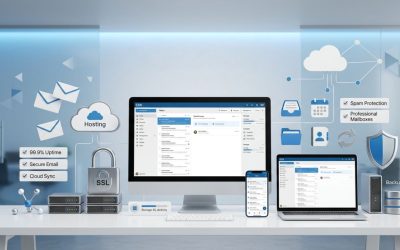
Because Hiya Digital operates as an authorized partner and reseller of OX App Suite rather than the owner of the underlying infrastructure, mailbox provisioning, license assignment, and plan-tier changes are handled through the reseller’s account management tools, while actual message delivery runs on Open-Xchange’s licensed platform. This reseller-managed model means a store can add or remove mailboxes as staffing changes occur without negotiating directly with the platform vendor, and support requests are routed through the reseller first for faster responses to day-to-day account questions.
Exact migration timelines and any temporary dual-running period during cutover vary by current provider and mailbox count, so confirming the specific plan for a store’s migration with the reseller directly, rather than assuming a generic timeline, avoids surprises. A store with under a dozen mailboxes typically completes a full migration faster than one running fifty-plus accounts across multiple departments, simply because there’s less to inventory and verify.
Ready to Move Your Store’s Email Off a Risky DIY Migration?
Getting DNS records, mailbox permissions, and every connected order-notification tool switched over correctly the first time avoids the lost confirmations and support delays that come with a rushed cutover. As an Authorized OX App Suite Partner, Hiya Digital handles provisioning and migration planning directly, so your store’s team doesn’t have to troubleshoot DNS propagation during a live sale.

Shared Calendars, Contacts, and Document Co-Editing for Store Teams
A fulfillment and support team spread across shifts or time zones needs shared scheduling and live document editing as much as it needs email, particularly around inventory counts and promotional planning.
Shared Calendars for Restock Dates and Promotional Campaigns
A shared team calendar showing restock dates, promotional campaign windows, and staff shift coverage prevents the common failure of a support team getting blindsided by a flash sale nobody told them about. OX Calendar syncs across the webmail interface and connected devices using the CalDAV protocol, an open standard that also lets staff subscribe to the shared calendar from third-party apps, such as a phone’s native calendar, if they prefer not to use the OX interface directly.
Calendar entries can include resource bookings, a shared warehouse scanner, a photo studio slot, alongside the event itself, and OX App Suite’s permission model lets an admin set a calendar to read-only for most staff while giving the marketing lead edit rights. A store running frequent flash sales benefits from color-coding these events by department, since a support rep scanning the calendar for “what’s happening this week” needs to distinguish a restock from a site-wide discount code launch at a glance.
Real-Time Document Collaboration on Product Descriptions and Policies
 Real-Time Document Collaboration on Product Descriptions and Policies
Store policy documents, return windows, shipping cutoffs, and warranty terms change often enough that emailing an updated Word file around invites version confusion, with someone inevitably working from an outdated copy weeks later. OX Documents, the platform’s built-in office suite, lets multiple staff edit a shared document simultaneously from the browser, with changes visible in real time rather than requiring a save-and-reshare cycle.
A practical application: a return policy document lives in OX Drive as an OX Documents file, editable directly by the operations lead, with support staff granted view-only access so they’re always reading the current version rather than a printout from three policy revisions ago. Product description drafts benefit the same way: a copywriter and a store owner can co-edit a listing in the same session, seeing each other’s cursor and changes live, which cuts the email-attachment-revision cycle that otherwise eats a surprising amount of time on a growing catalog.
Storage Planning for Seasonal Order Spikes
Order confirmation volume, customer support attachments, and marketing list growth all spike around major sales events, and storage limits that were comfortable in a slow month can fill up fast during a holiday rush.
Mailbox Storage Limits and What Fills Them Fastest
Support mailboxes accumulate attachments quickly: screenshots of damaged items, photo evidence for a warranty claim, scanned receipts from a wholesale buyer, and these fill storage space far faster than plain-text order confirmations do. A support@ mailbox handling image-heavy tickets during a busy season can approach its storage limit well before a low-traffic admin@ account does, even though both were provisioned with the same plan-tier allowance.
Storage limits and exact allowances vary by the specific OX App Suite plan tier a store is on, so checking current mailbox usage against the plan’s stated limit before a known high-volume period, rather than discovering the ceiling mid-sale, is worth building into a seasonal prep checklist. A quick habit that helps: archiving resolved support tickets with attachments to OX Drive on a monthly cadence, which frees mailbox storage without deleting the record entirely.
Pooled Storage Across Drives and Mailboxes for Growing Catalogs
Rather than treating mailbox storage and file storage as two separate, siloed limits, some OX App Suite plan tiers pool storage allowances across OX Drive and the mailbox, allowing storage to shift capacity toward whichever resource is under greater pressure at any given moment. A store with a large product photo library but relatively light email traffic can lean on that shared pool differently than a support-heavy operation with modest file storage needs.
This pooling matters most for a catalog that’s actively growing; new product shoots, updated packaging artwork, and seasonal lookbook files are continuously accumulated in OX Drive. At the same time, email volume remains relatively flat outside sale periods. Confirming whether a specific plan tier pools storage or enforces it separately per mailbox and per Drive account is a detail worth clarifying with the reseller at signup, since it directly affects whether an upgrade is needed sooner for one resource versus the other.
Mobile and Desktop Access for Owners and Support Staff
A store owner checking order status from a phone between meetings needs a genuinely different experience than a support agent working a full shift from a desktop client, and OX App Suite handles both without requiring two separate subscriptions.
Native Mobile Apps Versus Browser-Based Webmail
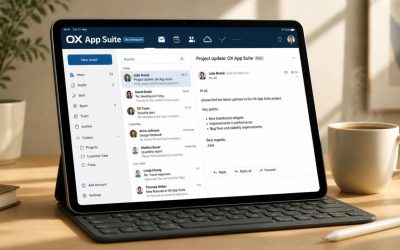
OX App Suite’s mobile apps for iOS and Android provide offline access to recently synced mail, push notifications for new messages, and native calendar integration. At the same time, the browser-based webmail interface offers the full administrative feature set, mailbox permission changes, filter rule creation, and storage management that the mobile apps intentionally simplify or omit. A store owner triaging urgent customer emails from a phone during a weekend gets a streamlined experience; a support supervisor adjusting team-wide filter rules needs the desktop browser interface to do it properly.
This split isn’t a limitation so much as a deliberate design choice: mobile apps prioritize speed and battery life over administrative depth, which is the right trade-off for the person checking mail on the go but the wrong one for anyone configuring accounts. A support team working primarily from desktops during shifts, with the owner checking in via mobile after hours, is a common and workable split rather than a compromise either side has to tolerate.
Syncing to Outlook and Other Native Mail Clients
Staff who prefer working from a familiar desktop client like Outlook rather than a browser tab can connect it to their OX App Suite mailbox, with calendar and contact sync handled through the same CalDAV/CardDAV standards used elsewhere on the platform, or through a dedicated connector for full Exchange-style synchronization. This matters for a support hire who’s spent years in Outlook and doesn’t want to relearn a new interface just because the store switched email providers.
The trade-off is that native client setup requires providing the correct incoming and outgoing server addresses, port numbers, and encryption settings during account configuration, a one-time task, but one where a typo in the server address is a common source of “my email isn’t syncing” support requests during onboarding. A short written setup guide, handed to each new hire on day one rather than verbal instructions, significantly reduces avoidable configuration errors.
OX App Suite Compared to Google Workspace and Microsoft 365
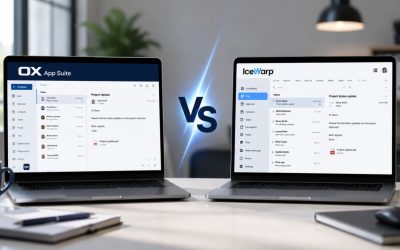
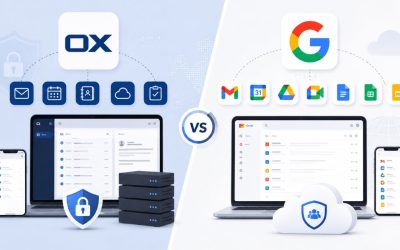
Store owners evaluating email providers almost always compare OX App Suite against Google Workspace and Microsoft 365, since those two dominate general awareness even though the underlying platforms differ meaningfully in how they handle collaboration permissions.
Where OX App Suite Diverges From the Big Two
Google Workspace and Microsoft 365 both bundle deep third-party app ecosystems and broader name recognition, which some stores value for hiring familiarity; a new employee has likely used Gmail or Outlook before. OX App Suite’s differentiation is tighter integration between mail, calendar, contacts, and document editing in a single interface without requiring separate app subscriptions layered on top, along with a permission model for shared calendars that separates “can view free/busy time” from “can view full event details” as distinct grant levels, rather than a single shared/not-shared toggle.
That distinction matters for a store where the owner wants staff to see that a restock meeting is happening at a given time without necessarily seeing the internal notes attached to that calendar entry. Google Workspace and Microsoft 365 handle granular calendar permissions differently, and a store evaluating platforms should test this specific behavior with their own use case, a supplier meeting with sensitive terms, for instance, rather than assuming all three platforms treat “shared calendar” identically.
Choosing Based on Team Habits, Not Just Feature Lists
The right platform choice depends heavily on what a store’s existing team is already comfortable using, since retraining staff on a new interface has a real productivity cost during the transition period, separate from any feature comparison. A five-person team that’s spent years in Gmail may find that the switching cost outweighs OX App Suite’s tighter integration, while a store building its team from scratch has no such sunk cost working against it when adopting a new platform.
OX App Suite vs. Google Workspace vs. Microsoft 365 for E-commerce Teams
| Criterion | OX App Suite | Google Workspace | Microsoft 365 |
|---|---|---|---|
| Calendar permission granularity | Separate free/busy vs. full-detail sharing levels | Combined sharing settings, fewer intermediate tiers | Combined sharing settings via Exchange permissions |
| Built-in encryption add-on | OX Guard (PGP and S/MIME, one-click) | Requires a third-party add-on for PGP-level encryption | S/MIME available; PGP requires third-party tools |
| Office suite included natively | OX Documents (text, spreadsheet, presentation) | Google Docs/Sheets/Slides | Office desktop or web apps, depending on the plan |
| File sync client | OX Drive (desktop, mobile, browser) | Google Drive | OneDrive |
| Mobile sync protocol | CalDAV/CardDAV plus EAS-based connector option | CalDAV/CardDAV native | Exchange ActiveSync native |
| Typical buyer familiarity | Lower: less consumer brand recognition | High; widely used personally and professionally | High; long enterprise history |
| Reseller-based provisioning common | Yes, frequently sold through hosting partners | Less common; often direct or via Google-authorized resellers | Common via Microsoft CSP partners |
| Ecosystem of third-party app integrations | Narrower | Extensive | Extensive |
Plan Tiers, Renewal Pricing, and What to Ask Before You Sign
Plan-tier structure and renewal pricing are where most post-signup frustration originates, usually because an introductory rate seemed appealing without a clear picture of the renewal price or storage ceiling a year later.
Introductory Pricing Versus Renewal Rates
 Introductory Pricing Versus Renewal Rates
Providers across the email hosting market commonly offer a lower introductory price for the first term, with renewal pricing stepping up at the next billing cycle, a structure that isn’t unique to any one platform but catches store owners off guard when they haven’t confirmed the renewal figure in writing at signup. Exact pricing tiers and renewal rates for OX App Suite vary by mailbox count and storage allocation. Whether add-ons like OX Guard or the full OX Documents suite are included, approximate ranges rather than a fixed number are the honest way to discuss cost before a formal quote.
A store budgeting for the coming year should ask specifically what the second-year renewal rate will be, whether that rate is locked in at signup or subject to change, and what happens to existing mailboxes and data if a downgrade to a smaller tier becomes necessary later. Getting these answers in writing from the reseller before signing avoids the scramble of an unexpected renewal invoice landing in the middle of a busy quarter.
Plan Tiers and Which Apps Each One Includes
Lower plan tiers typically include core email, calendar, and contacts. In comparison, higher tiers include OX Documents for full office suite editing, larger Drive storage allocations, and sometimes OX Guard as a bundled add-on rather than a separate purchase. A store that only needs reliable transactional email and shared contacts may not need the top tier at all, while one running heavy internal document collaboration on policies and product listings gets clear value from a tier that natively includes OX Documents.
The practical move before choosing a tier is listing which specific apps the team will actually use daily, not which ones sound useful in a features comparison, and matching that list against what each tier includes, rather than defaulting to the middle option because it seems like a safe compromise. A store can typically upgrade tiers later as needs grow, but confirming whether that upgrade preserves existing mail history and Drive files or requires a migration step is worth asking about up front rather than assuming.
Frequently Asked Questions
Does OX App Suite work with the shopping cart platform my store already uses?
OX App Suite handles mailbox hosting and doesn’t require any specific cart platform integration, since transactional emails from a cart system connect via standard SMTP credentials regardless of which platform is running the storefront. The practical step is to update the SMTP host, port, and authentication details in the cart platform’s email settings to point to the new mail server after the migration, rather than relying on an automatic connection. Most cart platforms, whether custom-built or a common hosted solution, support custom SMTP configuration in their settings panel. However, the exact menu location varies by platform, so checking that platform’s documentation on where to enter SMTP credentials saves time during setup.
What happens to the email history from my old mailboxes when I migrate?
Whether historical email transfers automatically during migration depends on the export tools available from the previous provider and whether that provider supports IMAP-based migration, which most modern hosts do. A reseller-assisted migration typically includes exporting existing mail via IMAP and importing it into the new OX App Suite mailboxes. Still, the completeness of that transfer, especially for very large mailboxes with years of attachments, should be confirmed and tested with a sample mailbox before the full team migrates, rather than assumed to be lossless by default.
Can I keep using Outlook if my team switches to OX App Suite?
Yes, OX App Suite mailboxes can connect to Outlook and other native desktop clients via standard IMAP/SMTP settings or a dedicated connector for calendar and contact sync, so staff isn’t forced to use the browser-based webmail interface if they prefer their existing client. The one detail worth testing before a full team rollout is calendar and contact sync behavior, specifically, since some advanced features, like shared calendar permission levels, may appear differently in a third-party client than in the native OX App Suite interface.
How does OX App Suite handle two-factor authentication for staff accounts?
OX App Suite supports multifactor authentication as an account-level security setting, and administrators can require it across all staff mailboxes rather than leaving it optional per user, which is the safer default for any account handling customer payment-related correspondence. For native mobile and desktop apps that don’t yet support the same MFA flow as the browser interface, application-specific passwords can be generated per device, letting a staff member’s phone stay connected without weakening the account’s primary login security.
Does OX App Suite automatically back up my store’s email?
Backup policies and retention periods are provider-specific and vary depending on the plan tier and hosting arrangement, so confirming the exact backup schedule and how far back a message can be recovered, a week, thirty days, or longer, is a question worth putting directly to the reseller rather than assuming a universal standard applies. For anything mission-critical, such as a signed wholesale contract received by email, exporting a copy to OX Drive or a separate archive independent of the mailbox itself adds a layer of redundancy beyond whatever the platform’s default backup policy covers.
Is OX App Suite suitable for a solo store owner, or is it built for larger teams?
A solo operator gets real value from custom-domain email, spam filtering, and cloud file sync, even without a team to share calendars or co-edit documents, since the core reliability and trust benefits apply regardless of headcount. The collaboration features become more valuable as the second and third hires come on board. Still, a single-person store isn’t paying for capabilities it can’t use. The base plan tiers are scoped for exactly this kind of lean operation rather than assuming enterprise headcount from day one.
What should I ask my reseller before signing a contract, beyond the price?
Beyond the introductory price, ask specifically what the renewal rate will be and whether it’s fixed or variable, what the process looks like for adding or removing mailboxes mid-term, what backup and data-export options exist if the store ever switches providers again, and who to contact for support versus who to contact for billing disputes. Getting these specifics in writing, not just a verbal assurance during a sales call, protects against the most common source of post-signup frustration: discovering a policy detail only after it becomes relevant.
Can multiple staff members securely share one support inbox?
Yes, through role-based permission grants rather than a shared password, an admin can grant several staff members full or send-as access to a single support@ mailbox, while each still logs in with their own credentials, preserving an audit trail of who sent or read what. This is a meaningfully different setup from the common small-business pattern of one shared login and password passed around the team, which makes it impossible to trace who took a specific action and creates a security risk the moment someone leaves and the password isn’t changed.
Does OX App Suite support custom domains for international storefronts running separate country-specific sites?
Each additional domain added to an account needs its own MX, SPF, DKIM, and DMARC records configured and its own DKIM key pair generated and published, since these records are domain-specific and don’t extend automatically from a primary domain to a secondary one. A store running separate country-code domains for different markets should treat each domain’s DNS setup as an independent task during onboarding, confirming with the reseller how additional domains are licensed under the account before assuming they’re included at no extra cost.
How much does OX App Suite typically cost per mailbox for a small e-commerce team?
Pricing varies by mailbox count, storage tier, and which add-ons, like OX Guard or full OX Documents access, are included, so a specific figure isn’t meaningful without those details. Approximate ranges depend on the reseller’s current plan structure and any volume-based reseller discounts applied at signup. A more useful question for budgeting purposes than “what’s the price” is “what’s included at each tier and what does the renewal rate look like a year from now,” since the headline monthly figure alone rarely reflects the full annual cost once storage add-ons or extra mailboxes are factored in.
Glossary
MX record: A DNS entry that specifies which mail server receives incoming email for a domain.
SPF (Sender Policy Framework): A DNS TXT record listing which servers are authorized to send email on a domain’s behalf, defined under RFC 7208.
DKIM (DomainKeys Identified Mail): A cryptographic signature attached to outgoing email that lets receiving servers verify the message wasn’t altered and came from an authorized sender.
DMARC (Domain-based Message Authentication, Reporting and Conformance): A policy layer that tells receiving mail servers how to handle messages that fail SPF or DKIM checks, and generates reports on spoofing attempts.
IMAP/POP3: Protocols for retrieving email from a server; IMAP keeps mail synced across devices, while POP3 typically downloads and removes it from the server.
SMTP: The protocol used to send outgoing email between mail servers.
TLS/STARTTLS: Encryption protocols that protect email content while it’s in transit between servers.
CalDAV/CardDAV: Open standards for syncing calendar and contact data across devices and applications.
OX Guard: OX App Suite’s integrated PGP and S/MIME encryption add-on for securing individual emails and files.
OX Drive: OX App Suite’s built-in cloud file storage and synchronization component.
OX Documents: OX App Suite’s integrated office suite for online document, spreadsheet, and presentation editing.
Reseller-managed provisioning: An arrangement where an authorized partner handles account setup, mailbox provisioning, and support, while the underlying platform is licensed from the original vendor.
The Hiya Digital Team is a collective of IT infrastructure specialist engineers, certified systems administrators, and cloud architects driven by a singular mission: building corporate communication systems that just work. As an Authorized Google Partner, the team handles complex global hosting deployments, secure email migrations, and advanced data compliance architectures for businesses across 40+ countries.
With over two decades of technical experience spanning custom premium business email configurations, OX AppSuite deployments, and enterprise-level network security, the Hiya Digital Team writes to demystify domain infrastructure. Their content focuses on actionable technical strategies, anti-phishing security protocols, and seamless cloud collaboration setup, all backed by real-world deployment experience and 24/7 technical support accountability.