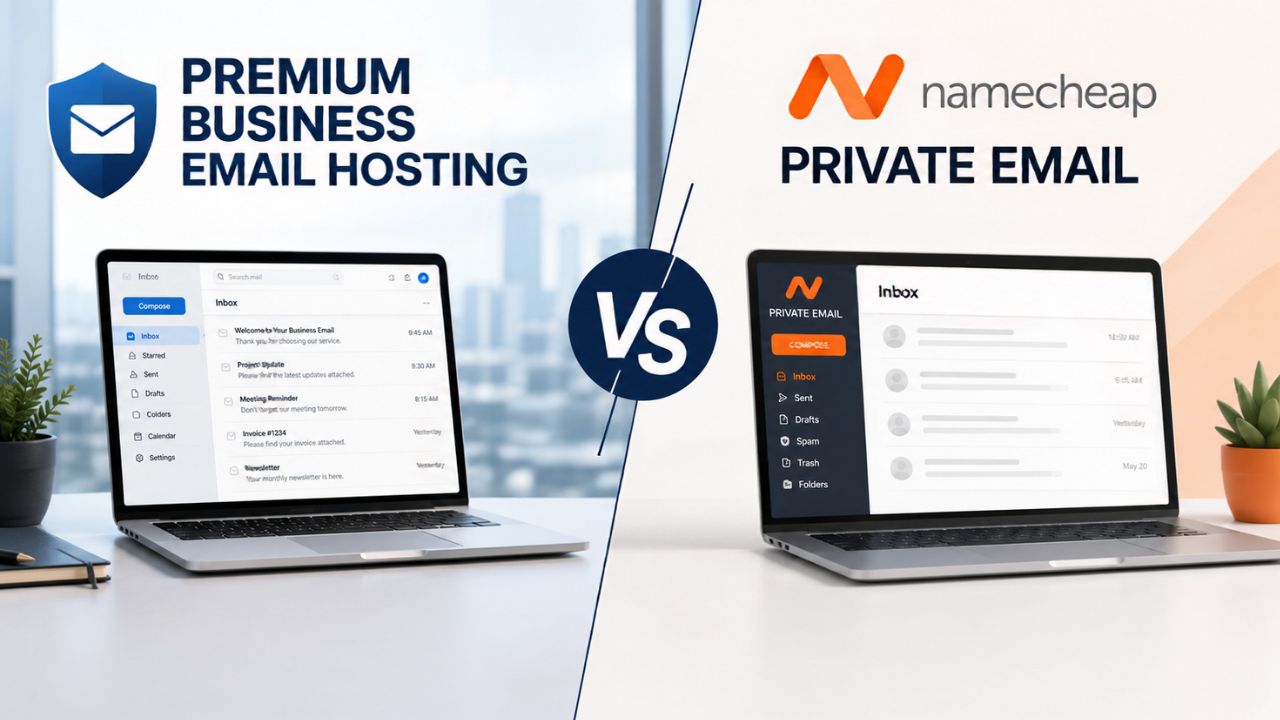
Choosing between Premium Business Email Hosting and Namecheap Private Email comes down to one question: do you want a managed, support-heavy mailbox built around your business, or a budget-friendly mailbox bundled with the domain registrar you already use?
Mailbox Storage and Space Management
Storage is the first constraint most growing teams hit, and the two platforms size it very differently. Namecheap assigns storage per mailbox by plan tier. At the same time, Premium Business Email Hosting sets a flat allowance per user regardless of how many mailboxes a business runs, which changes how far a team can scale before anyone has to think about quota again.
 How much mailbox space each plan actually gives you
 How much mailbox space each plan actually gives you
Namecheap’s Starter plan gives each mailbox 5GB of storage; Pro plans increase it to 10GB per mailbox; and Ultimate reaches 15GB per mailbox, according toNamecheap’s own storage distribution documentation. Premium Business Email Hosting’s Standard plan includes 25GB per user, with Plus-tier users receiving additional cloud storage layered on top of that base allowance. Both platforms let administrators shift unused space between mailboxes rather than locking each account to a fixed ceiling.
The practical difference shows up during busy quarters. A sales team that lives on signed contracts, proposal decks, and long client threads will hit a 5GB or 10GB ceiling faster than a 25GB one, and every minute spent archiving or deleting to make room is a minute not spent on client work. Attachment size matters here too: Premium Business Email Hosting supports attachments up to 50MB, which covers most design files and signed PDFs without requiring a separate file-sharing workaround for routine client documents.
Redistributing storage without disrupting other mailboxes
Both platforms let an admin move storage from a lightly used mailbox to a more heavily used one, rather than forcing an immediate plan upgrade, which is useful for a team with uneven usage across roles. Namecheap’s redistribution tool operates at the individual mailbox level. It requires manually rebalancing each account through the account dashboard whenever usage patterns shift, a process documented step by step in its support knowledge base.
Premium Business Email Hosting’s per-user model reduces the frequency of manual rebalancing because the baseline allowance is sufficient for most day-to-day business use, so redistribution is unnecessary. For a five-person team where one person handles most client correspondence and another rarely touches email, the wider baseline buys more runway before anyone needs to intervene, which matters most for small teams without a dedicated IT admin watching quota dashboards.
Spam Filtering and Malware Protection
Every inbox is a target, and both platforms filter incoming mail before it reaches a user. Still, the depth of that filtering differs in ways that matter once a business becomes a more visible phishing target. Understanding what each system actually watches for helps set realistic expectations rather than assuming “spam filter included” means the same thing everywhere.
What each anti-spam system watches for
Namecheap’s Private Email plans include Jellyfish Anti-Spam Protection, described in Namecheap’s own materials as a machine-learning-based filter that runs across all three plan tiers without an additional cost. Premium Business Email Hosting layers sender reputation analysis, content pattern scanning, and behavioral signal detection simultaneously, flagging sending sources that deviate from an established baseline, such as a sudden spike in volume or an unusual recipient spread, before the individual messages are confirmed malicious.
The behavioral layer is the meaningful difference for a business handling wire transfers, vendor invoices, or client onboarding paperwork. Phishing emails that impersonate a known contact rarely trip a keyword filter because they contain no suspicious links or attachments; they rely entirely on looking legitimate. A system that also weighs sender authentication history and domain registration age catches that category of attack earlier than one built primarily around known signatures and flagged keywords.
Malware scanning at the message level
Premium Business Email Hosting scans every incoming message and attachment in real time against an actively updated library of malware signatures and ransomware variants at the server level, requiring no client-side software or manual checks from end users. This runs before a message reaches any inbox, which matters for organizations handling signed contracts or financial documents where a single infected attachment reaching the wrong person can compromise an entire network.
Namecheap’s publicly documented plan comparisons emphasize spam filtering and two-factor authentication as the primary account security layers, with malware-specific scanning receiving less detailed public documentation than the anti-spam system. That’s not necessarily an absence of protection. Still, it is a meaningful difference in how much a prospective buyer can verify about attachment-level scanning before purchasing, versus a platform that documents its scanning approach in detail up front.
Domain Security: SPF, DKIM, and DMARC
Domain-level authentication decides whether outbound mail lands in an inbox or a spam folder, and whether someone else can convincingly spoof your company’s domain. Both products support the same three authentication standards, but who configures them and who watches the resulting reports afterward is where the two platforms diverge.
Who sets up your authentication records
Premium Business Email Hosting configures SPF, DKIM, and DMARC automatically for every domain during setup, with no manual DNS work required from the business itself, and a support team actively monitors the resulting DMARC aggregate reports during the first 30 days after setup to flag legitimate sending sources that still need to be added to the SPF record. Namecheap’s Private Email documentation covers manual configuration of these same records via its DNS management tools, with setup guidance available in its knowledge base, but no dedicated onboarding review built into the plan itself.
That distinction matters because a DMARC policy moved to enforcement too early, before every legitimate sending source (a CRM, a marketing platform, a helpdesk tool) has been identified, is the most common reason a business’s own emails start getting blocked after tightening its policy. A managed 30-day review catches that failure mode before it happens rather than after a business notices its own newsletter bouncing.
Verifying your own setup either way
Regardless of which platform hosts a mailbox, any business can independently verify its own DMARC record using a tool like MXToolbox’s DMARC lookup, checking for a policy of p=quarantine or p=reject at the enforcement stage, a rua tag pointing to a working reporting inbox, and strict alignment settings. This step is worth doing on any platform, since misconfigured authentication is one of the most common reasons legitimate business email ends up in a spam folder regardless of which host is behind it.
For a business without in-house DNS expertise, the practical difference is less about whether the records can be configured correctly and more about who is watching them after go-live. A platform that reviews reports on a business’s behalf during the riskiest onboarding window removes a task that otherwise relies on someone remembering to check a report most non-technical admins have never looked at before.
Migration Experience and Data Transfer
Moving an existing mailbox is the single biggest source of hesitation when evaluating a new email platform, and the two products handle that transition very differently: one provides hands-on migration support as part of the service, the other relies on the customer’s own tools.
Managed migration versus self-serve tools
Premium Business Email Hosting’s migration process is handled by its own team from start to finish, including full message history, folder structures, and organizational hierarchy, with a parallel sync period run before cutover and a line-by-line verification of message counts before the old account is decommissioned. Namecheap’s Private Email plans rely on the customer configuring their own migration using standard IMAP-based transfer tools or a desktop client’s built-in import feature, without a dedicated migration team handling the process end-to-end.
For a business migrating a single, lightly used mailbox, self-serve tools are usually sufficient, and the cost difference is real. For a business migrating a shared team inbox with years of client history, folder hierarchies that mirror an org chart, and calendar entries tied to ongoing projects, an unsupervised IMAP transfer poses a greater risk of dropped folders or missing messages than a supervised, verified cutover.
What happens to contacts and calendar data
 What happens to contacts and calendar data
Contact and calendar records are business-critical in a way that’s easy to underestimate until they’re missing after a migration. Premium Business Email Hosting treats calendar entries and contact records with the same verification rigor as email history itself, confirming that every entry has transferred completely before a business makes the final switch, which prevents a team from rebuilding address books or re-entering recurring meetings on their first day on a new platform.
Namecheap’s own migration guidance focuses primarily on mail transfer via IMAP, with contact and calendar migration typically handled through separate export/import steps in whichever client the business uses. This process works but shifts more of the verification burden to the customer, rather than to a dedicated migration team confirming completeness before cutover.
Collaboration and Productivity Tools
Email rarely exists in isolation anymore; most teams expect calendars, shared files, and basic document tools to be available within the same login. Both platforms include some version of this, but the depth of what’s bundled and which plan tier unlocks it differ meaningfully.
What’s included at each tier
Namecheap’s Private Email is built on Open-Xchange, giving Pro and Ultimate plan subscribers access to shared contact folders, a file storage module called Drive, and a customizable information portal, according to Namecheap’s webmail features documentation, features that are more limited or unavailable on the entry-level Starter plan. Premium Business Email Hosting includes shared calendars, cloud file storage, and browser-based document creation and editing across its plans, positioning collaboration as baseline infrastructure rather than an upsell reserved for higher tiers.
The practical effect is that a Namecheap Starter subscriber comparing headline pricing against Premium Business Email Hosting isn’t actually comparing equivalent feature sets; the collaboration tools that come standard on one platform require an upgrade on the other, which is worth factoring in before assuming the entry-level tiers are functionally identical.
Real-time document collaboration in practice
Where Namecheap’s Open-Xchange-based Drive module supports file storage, version history, and sharing among Pro and Ultimate users, Premium Business Email Hosting’s document tools are built for teams that produce reports, proposals, and spreadsheets directly in-browser without switching to a separate office suite, with collaborative edits visible to every contributor in real time.
For a small team that already relies on a separate office suite for document work, this may be a redundant feature on either platform. For a team without one, the difference between a file-storage module bundled into higher tiers and productivity tooling included from the start can change how many separate subscriptions a growing business ends up managing.
Premium Business Email Hosting vs Namecheap Private Email
| Feature | Premium Business Email Hosting | Namecheap Private Email |
|---|---|---|
| Storage per user | 25GB (Standard), plus added cloud storage on Plus | 5GB (Starter), 10GB (Pro), 15GB (Ultimate) per mailbox |
| Attachment size limit | Up to 50MB per attachment | Not publicly specified at the same level of detail |
| Managed migration | Full-service, including parallel sync and post-migration verification | Self-serve, primarily via IMAP transfer tools |
| DNS/authentication setup | SPF, DKIM, DMARC configured automatically, plus 30-day DMARC monitoring | Manual configuration via account DNS tools |
| Malware scanning | Real-time server-level scanning of every message and attachment | Anti-spam (Jellyfish) documented in detail; malware-specific scanning less detailed publicly |
| Collaboration tools | Shared calendars, cloud storage, and document editing included across plans | Shared contacts, Drive file storage, and Portal available on Pro/Ultimate only |
| Mobile sync protocols | IMAP, POP, SMTP with native cross-device sync | IMAP, POP3, SMTP, plus CalDAV/CardDAV on the updated platform generation |
| Compliance attestations | SOC 3, HIPAA-audited infrastructure, PCI DSS AOC via infrastructure partner | Not listed in public Private Email plan documentation |
| Deleted-mail recovery | Self-service restore of messages or full mailboxes, all tiers | Dashboard-based mailbox administration; self-service recovery window not detailed publicly |
| Batch/enterprise migration | Staged, department-by-department migration for large mailbox counts | Primarily individual mailbox transfer tools |
Get Set Up on Premium Business Email Hosting the Right Way
A business that wants its email infrastructure managed rather than self-administered gets more of that built in with Premium Business Email Hosting. Hiya Digital, as an Authorized Reseller and Implementation & Migration Partner, handles setup, DNS authentication, and mailbox provisioning so a team can move without having to absorb the technical work themselves. Contact our team to scope your migration before you commit to a plan.

Mobile Access and Cross-Device Sync
A mailbox that only works well on a desktop doesn’t match how most teams actually operate today. Both platforms support mobile access, but the protocols and sync depth behind that access differ most noticeably during device switches or when working on an unfamiliar network.
Protocol support across devices
 Protocol support across devices
Premium Business Email Hosting supports IMAP, POP, and SMTP for connecting to any major desktop or mobile client, along with native mobile sync that automatically keeps email, contacts, and calendar entries updated across every device. Namecheap’s Private Email also supports IMAP, POP3, and SMTP for client connectivity, and its updated platform generation adds CalDAV and CardDAV support specifically for syncing calendars and contacts across compatible applications and devices, according to Namecheap’s own platform update documentation.
For a business standardized on Outlook, Apple Mail, or Thunderbird, any of these platforms can connect without retraining the team on a new interface. The meaningful gap shows up for teams relying on native calendar apps outside those major clients, where CalDAV/CardDAV support (present in Namecheap’s newer plan generation) versus proprietary sync (Premium Business Email Hosting’s approach) determines which third-party calendar tools will sync cleanly out of the box.
What changes when you switch devices
Actions taken on one device- reading a message, replying, moving something to a folder- reflect instantly across every other device on both platforms, removing the older experience of a mobile inbox falling out of sync with a desktop client. Where the two diverge is update cadence: Namecheap’s own documentation notes that its legacy platform generation required scheduled maintenance windows for larger feature releases, while its updated architecture is designed to ship improvements more continuously.
Premium Business Email Hosting’s infrastructure team manages updates and monitoring as part of the managed-service model, meaning a business isn’t tracking which platform generation its own subscription happens to be running, an operational detail Namecheap customers on legacy plans currently need to track themselves until their migration to the newer architecture completes.
Admin Controls and Account Management
The administrator experience determines how much ongoing work a growing team creates for whoever manages the company’s email accounts. A platform with strong admin tooling reduces that overhead; one without it pushes routine account changes into support tickets.
Managing mailboxes, aliases, and forwarding
Premium Business Email Hosting lets an administrator create email addresses for every employee, department, and role from a single control panel, with aliases like sales@ and support@ that deliver to existing mailboxes without separate accounts, plus forwarding rules that automatically route messages during role transitions. Namecheap’s plans include alias support at every tier, with the number of aliases scaling by plan (10 on Starter, up to unlimited on Ultimate), managed through its own account dashboard.
Both approaches solve the same underlying problem: a growing business needs more external-facing addresses than it needs actual mailboxes. Where they differ is depth of forwarding logic and how much of that configuration is handled proactively versus requiring the administrator to set each rule manually as the org chart changes.
Restoring deleted mail and mailboxes
Premium Business Email Hosting retains deleted messages for a defined recovery period across all plan tiers, allowing an administrator or user to restore individual messages or entire mailboxes directly from the control panel without opening a support ticket, which matters when a deleted contract thread or compliance record carries real legal weight. Namecheap’s account management tools include mailbox-level administration through its dashboard, though public documentation is less specific about a defined self-service recovery window comparable to a full mailbox restore.
For a business in a regulated industry, or any business that has been burned once by an accidentally deleted client thread, the presence of a clearly documented, self-service recovery window (rather than a support-ticket-dependent process) is worth confirming directly with either provider before signing a contract, since this is exactly the kind of feature that only matters the day something actually goes wrong.
Plan Structure and Contract Terms
Beyond feature checklists, the structural shape of a plan, how many mailboxes are bundled, what triggers an upgrade, and how contracts are billed, affects the total cost of ownership as a team grows, independent of the sticker price on either side.
How mailboxes and tiers scale
Namecheap’s plan structure bundles a fixed number of mailboxes per tier: Starter includes 1 mailbox, Pro includes 3, and Ultimate includes 5. Additional mailboxes are purchased individually beyond that allotment, a structure confirmed in Namecheap’s plan comparison documentation. Premium Business Email Hosting’s Standard and Plus tiers are structured around per-user pricing that scales linearly as a business adds employees, without needing to jump to a materially different plan tier to add a handful of accounts.
For a business anticipating steady headcount growth rather than sudden jumps, a linear per-user structure avoids the plan-tier cliff that comes with bundled-mailbox pricing, where adding a sixth person on a five-mailbox plan means either an individual add-on purchase or a full tier upgrade, depending on the provider’s own rules for that transition.
Contract length and commitment
Premium Business Email Hosting does not require long-term contracts, giving businesses the flexibility to adjust their plan without being locked into an annual commitment. Namecheap’s Private Email plans are billed on an annual cycle by default, with domain-bundled purchases (a natural pairing given Namecheap’s core business as a domain registrar) often reinforcing that annual commitment across both services.
For a business that already registers its domains through Namecheap, bundling email onto the same annual renewal cycle simplifies billing into a single vendor relationship. For a business that wants its domain registrar and its email provider decoupled, or that wants the flexibility to change providers without waiting out an annual term, a no-long-term-contract structure removes that timing constraint entirely.
Plan Structure Comparison
| Structural Element | Premium Business Email Hosting | Namecheap Private Email |
|---|---|---|
| Plan tiers | Standard, Plus | Starter, Pro, Ultimate |
| Mailboxes included | Priced per user, scales linearly | 1 (Starter), 3 (Pro), 5 (Ultimate) bundled per tier |
| Additional mailbox model | Add per user as needed | Purchased individually beyond the bundled allotment |
| Contract commitment | No long-term contract required | Annual billing cycle is the default structure |
| Domain bundling | Domain-independent; works with any registrar | Frequently bundled with Namecheap domain registration |
| Enterprise/custom plans | Available via direct account management for larger teams | Custom plan available beyond 50 mailboxes or 20 domains |
| Trial availability | Available on request through onboarding | 60-day free trial with no payment details required upfront |
Compliance and Data Protection Configurations
Regulated industries and businesses handling sensitive client data need more than baseline encryption; they need documented, auditable infrastructure behind the mailbox. This is one of the more consequential differences between the two platforms, and it’s worth verifying directly with either provider before signing anything.
What’s documented versus available on request
Premium Business Email Hosting’s infrastructure partner maintains independently audited compliance programs, including SOC 3, HIPAA-audited infrastructure, and a PCI DSS Attestation of Compliance, with GDPR-aligned data residency and configurable email archiving retention periods available on request for organizations under legal hold requirements. Namecheap’s publicly available Private Email documentation focuses on account-level protections, two-factor authentication, SSL/TLS encryption, and Jellyfish Anti-Spam. Still, it does not list equivalent, independently audited infrastructure attestations specifically for the Private Email product.
That doesn’t mean Namecheap’s infrastructure is unsafe; it means a business with a specific compliance requirement (a signed Business Associate Agreement for HIPAA, a documented SOC report for a vendor security review) will need to confirm those specifics directly with Namecheap’s support team, since the publicly published plan comparisons don’t address them the way Premium Business Email Hosting’s documentation does.
End-to-end encryption for sensitive communications
 End-to-end encryption for sensitive communications
Standard AES-256 encryption at rest and TLS in transit protect data on both platforms, but neither provides true end-to-end encryption between sender and recipient by default. Premium Business Email Hosting offers S/MIME certificate configuration on request for businesses handling legally privileged, clinical, or sensitive financial communications, layered on top of its standard infrastructure rather than replacing it.
A business that genuinely needs message-level encryption beyond standard transport security, rather than assuming AES-256-at-rest already covers that need, should confirm the specific configuration path with whichever provider it’s evaluating, since “encrypted” on a features page can mean several different things depending on which layer of the message lifecycle it actually protects.
Scalability for Growing Teams
A platform that fits a five-person team today needs to still make sense at fifty. How each product handles that growth, in mailbox provisioning, storage expansion, and migration support for larger batches, shapes how disruptive scaling actually feels.
Adding users without service disruption
Premium Business Email Hosting scales by adding users, storage, and features without requiring migrations, new contracts, or service interruptions, and its team has directly supported companies moving from ten to fifty users without changing existing addresses or folder structures. Namecheap accommodates growth by allowing customers to purchase additional mailboxes beyond a plan’s included allotment or upgrade to a higher tier, with a documented path to a custom plan for businesses needing more than 50 mailboxes or Private Email across more than 20 domains.
Both platforms can technically support a growing team. The difference is in how much of that growth requires the business’s own IT staff to manage the transition versus how much is handled by the provider as part of the existing service relationship.
Batch migrations for larger organizations
For an enterprise-scale migration involving hundreds of mailboxes at once, Premium Business Email Hosting stages the process in batches specifically to preserve continuity across departments throughout the transition, an approach built for the scenario where different teams can’t all go offline simultaneously. Namecheap’s documented migration tools are built primarily around individual mailbox transfers rather than a staged, department-by-department batch process for large-scale organizational moves.
For a small team, this distinction rarely matters. For an organization moving from a few dozen mailboxes to the hundreds, it becomes one of the more consequential differences between the two platforms, since an unsupervised transfer at that scale carries a meaningfully higher risk of data loss than a supervised, staged one.
Decision Summary: Which Fits Your Business?
| Buyer Profile | Better Fit | Why |
|---|---|---|
| Regulated business needing documented compliance attestations | Premium Business Email Hosting | Published SOC 3, HIPAA-audited infrastructure, and PCI DSS AOC provide a documented compliance trail not detailed in Namecheap’s public documentation. |
| Team migrating hundreds of mailboxes at once | Premium Business Email Hosting | Staged batch migration helps maintain continuity at a scale beyond typical self-serve IMAP migration tools. |
| Solo freelancer already registering a domain through Namecheap | Namecheap Private Email | Bundling a mailbox with an existing Namecheap domain keeps billing simple and reduces the number of service providers. |
| Team that wants collaboration tools included without upgrading tiers | Premium Business Email Hosting | Shared calendars, cloud storage, and document tools are included across plans rather than limited to higher tiers. |
| Business testing the waters before any commitment | Namecheap Private Email | A 60-day free trial without payment details required offers a low-friction way to evaluate the service. |
| Organization with a DMARC policy it doesn’t want to babysit alone | Premium Business Email Hosting | Automatic SPF, DKIM, and DMARC setup with 30-day monitoring reduces the ongoing DNS management burden. |
| Business wanting to decouple domain registrar from email provider | Premium Business Email Hosting | Domain-independent setup lets businesses use any registrar without linking email services to domain renewal cycles. |
Frequently Asked Questions
Which is better for a small business, Premium Business Email Hosting or Namecheap Private Email?
It depends on how much your team wants managed versus self-serve. Namecheap’s Starter plan works well for a solo operator or a very small team on a tight budget, especially if you’re already registering a domain through Namecheap. Premium Business Email Hosting is ideal for a small business that wants migration, DNS authentication, and DMARC monitoring handled by a support team rather than configured in-house. A five- to fifteen-person team typically completes onboarding for Premium Business Email Hosting within a single working day, which matters if internal IT bandwidth is limited. Storage is also a factor: Premium Business Email Hosting’s 25GB-per-user baseline gives more runway than Namecheap’s 5GB Starter tier before anyone hits a quota wall.
How much mailbox storage do I get with Namecheap Private Email compared to Premium Business Email Hosting?
Namecheap allocates storage per mailbox by plan: 5GB on Starter, 10GB per mailbox on Pro, and 15GB per mailbox on Ultimate, according to Namecheap’s storage distribution documentation. Premium Business Email Hosting’s Standard plan includes 25GB per user, with Plus-tier users receiving additional cloud storage layered on top. Both platforms let administrators redistribute unused storage between mailboxes rather than locking each account to a fixed cap. For teams that handle large attachments regularly, Premium Business Email Hosting also supports files up to 50MB per attachment, reducing the frequency with which large files require a separate transfer method.
Can I migrate from Namecheap Private Email to Premium Business Email Hosting without losing data?
Yes. Premium Business Email Hosting’s migration process moves full message history, folder structures, contacts, and calendar entries, and runs a parallel sync period before any cutover happens. The team verifies message counts and folder structures after the transfer and only decommissions access to the old mailbox once the destination has been confirmed complete through a line-by-line check. This differs from a self-serve IMAP transfer, which places more of the verification responsibility on the business itself. For a shared team inbox with years of history, a supervised, verified migration carries meaningfully lower risk than an unsupervised one run through a desktop client’s import tool.
Does Namecheap Private Email include the same security features as Premium Business Email Hosting?
Both include spam filtering and encryption in transit, but the depth differs. Namecheap documents Jellyfish Anti-Spam Protection, a machine-learning-based filter, plus two-factor authentication and SSL/TLS encryption across all tiers. Premium Business Email Hosting layers in sender reputation analysis, behavioral pattern detection, and real-time malware scanning of every message and attachment at the server level, in addition to SPF, DKIM, and DMARC, configured automatically, with a 30-day monitored review period. Namecheap’s public documentation is less detailed about attachment-level malware scanning, so a business with strict attachment-security requirements should confirm those specifics directly with Namecheap before assuming parity.
Is Namecheap Private Email good for teams that need shared calendars and collaboration tools?
It can work, but collaboration features are gated by tier. Namecheap’s Private Email runs on Open-Xchange, and shared contact folders, the Drive file storage module, and the Portal dashboard are available on the Pro and Ultimate plans, with more limited functionality on the Starter plan. Premium Business Email Hosting includes shared calendars, cloud file storage, and browser-based document editing across its plans without requiring an upgrade to unlock them. A team comparing entry-level pricing across both platforms should check whether the cheaper tier actually includes the collaboration tools it’s evaluating, since Namecheap’s Starter plan and its higher tiers aren’t functionally equivalent in this regard.
What happens if I outgrow the Namecheap Starter plan?
You’ll need to either purchase additional mailboxes individually at each tier’s per-mailbox add-on rate or upgrade to Pro or Ultimate to get more bundled mailboxes and storage per account. Namecheap’s plan structure is built around fixed mailbox counts per tier (one on Starter, three on Pro, five on Ultimate), so growth beyond that allotment means an incremental purchase decision each time headcount changes. Premium Business Email Hosting’s per-user pricing scales linearly instead, so adding one more employee is the same type of transaction whether a team has five people or fifty, without hitting a tier boundary that forces a larger plan change.
Does Premium Business Email Hosting require an annual contract like Namecheap?
No. Premium Business Email Hosting does not require a long-term contract, giving a business flexibility to adjust its plan as its needs change. Namecheap’s Private Email plans are billed annually by default. Because Namecheap is primarily a domain registrar, email is frequently bundled with a domain purchase on the same yearly renewal cycle. For a business that wants its domain registrar and email provider on separate timelines, or that wants to avoid being locked into a full year before making a change, a no-long-term-contract structure removes that constraint. For a business already comfortable with renewing its domain and email together annually, the bundled cycle simplifies billing into a single relationship.
Which service offers better support for compliance requirements like HIPAA or GDPR?
Premium Business Email Hosting’s infrastructure partner maintains independently audited programs including SOC 3, HIPAA-audited infrastructure, and a PCI DSS Attestation of Compliance, with GDPR-aligned data residency and configurable archiving retention available on request. Namecheap’s publicly available Private Email documentation focuses on account-level protections such as two-factor authentication and TLS encryption. Still, it does not list equivalent, independently audited infrastructure attestations specifically for the Private Email product. A business with a specific compliance obligation, such as needing a signed Business Associate Agreement for HIPAA, should confirm the exact documentation available directly from the provider it’s evaluating before finalizing its decision.
Can I keep my domain registrar separate if I switch to Premium Business Email Hosting?
Yes. Premium Business Email Hosting is domain-independent and works with a domain registered through any registrar, so switching email providers doesn’t require moving your domain registration. This differs from Namecheap’s typical purchase pattern, in which Private Email is frequently purchased alongside a Namecheap-registered domain, bundling both services under a single renewal cycle if your business wants to decouple where its domain lives from where its email is hosted, whether for redundancy, vendor diversification, or simply preferring to manage each separately, Premium Business Email Hosting’s setup process doesn’t require any change to your existing domain registration.
How long does it take to switch from Namecheap Private Email to Premium Business Email Hosting?
Timelines depend on team size and mailbox volume, but Premium Business Email Hosting’s process is designed to minimize operational disruption throughout. A small business team of five to fifteen people is typically fully migrated and operational within a single working day. At the same time, larger migrations involving hundreds of mailboxes are staged in batches to preserve continuity across departments. The platform runs a parallel sync before cutover. It completes a line-by-line verification of message counts and folder structures before decommissioning the old account, so the switch is designed to be effectively invisible to day-to-day operations rather than requiring team-wide downtime.
Glossary
SPF (Sender Policy Framework): A DNS record that lists which mail servers are authorized to send email on behalf of a domain, helping receiving servers detect spoofed messages.
DKIM (DomainKeys Identified Mail): An email authentication method that attaches a digital signature to outgoing messages, letting receiving servers verify the message wasn’t altered in transit.
DMARC (Domain-based Message Authentication, Reporting & Conformance): A policy layer built on top of SPF and DKIM that tells receiving servers what to do with messages that fail authentication, and provides reporting back to the domain owner.
TLS (Transport Layer Security): The encryption protocol that protects data moving between mail servers in transit, preventing interception during delivery.
AES-256: A widely used encryption standard for protecting data at rest, referring to the 256-bit key length used to secure stored information.
S/MIME (Secure/Multipurpose Internet Mail Extensions): A certificate-based standard that adds end-to-end, recipient-keyed encryption at the individual message level, beyond standard transport or at-rest encryption.
2FA (Two-Factor Authentication): A login security method requiring a second verification step, in addition to a password, before granting account access.
IMAP / POP3 / SMTP: The three core email protocols governing how messages are retrieved, stored, and sent between mail clients and servers.
CalDAV / CardDAV: Standard protocols for syncing calendar and contact data across different applications and devices.
Mailbox quota: The storage limit assigned to an individual email account, after which new messages may be rejected until space is freed or increased.
Alias: An additional email address that delivers to an existing mailbox without requiring a separate account, commonly used for role-based addresses like sales@ or support@.
Open-Xchange: The open-source collaboration software platform that powers Namecheap Private Email’s webmail, calendar, and file-storage modules.
The Hiya Digital Team is a collective of IT infrastructure specialist engineers, certified systems administrators, and cloud architects driven by a singular mission: building corporate communication systems that just work. As an Authorized Google Partner, the team handles complex global hosting deployments, secure email migrations, and advanced data compliance architectures for businesses across 40+ countries.
With over two decades of technical experience spanning custom premium business email configurations, OX AppSuite deployments, and enterprise-level network security, the Hiya Digital Team writes to demystify domain infrastructure. Their content focuses on actionable technical strategies, anti-phishing security protocols, and seamless cloud collaboration setup, all backed by real-world deployment experience and 24/7 technical support accountability.