
Deploying Google Workspace Enterprise across multiple countries requires careful planning to support regional operations while maintaining consistent security, governance, and user management. Organizations must consider factors such as data residency, privacy regulations, identity management, regional administration, and around-the-clock operational support to meet both business and compliance requirements. Understanding these multi-region considerations helps global enterprises create a secure, scalable, and well-governed collaboration environment for teams operating across different locations and time zones.
Google Workspace For Enterprise Features →
Data Regions: Choosing Where Covered Data Lives
Google Workspace’s data regions feature lets an administrator assign covered data to a specific geographic location rather than leaving placement to Google’s default global infrastructure. For a multinational organization, this single setting often serves as the anchor for all subsequent regional compliance decisions.
 What a Data Region Policy Actually Controls
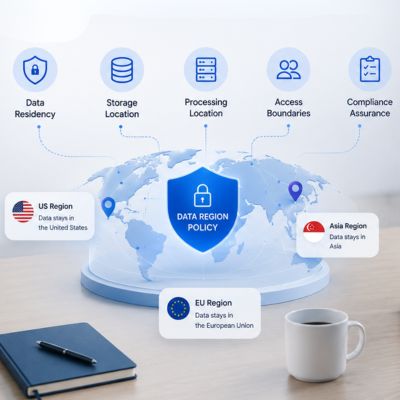 What a Data Region Policy Actually Controls
A data region policy in the Google Admin console offers three location choices: the United States, Europe, or no preference, and it applies to data at rest, including backups, across a defined set of core services such as Gmail, Drive, Calendar, and Meet recordings. Setting a policy does not change network routing or improve latency for end users; it changes where the underlying storage infrastructure physically holds that data. Organizations sometimes assume region selection is a performance lever; it is a residency lever, and conflating the two leads to mismatched expectations during procurement conversations with regional stakeholders who care about jurisdiction, not milliseconds.
Coverage also varies by service and by data type, so a policy that looks comprehensive at the organizational-unit level may still leave certain processing activities outside the selected region. Admins should review Google’s published list of covered services before presenting a data region policy as a complete residency solution to auditors or works councils. A common gap large organizations discover late is that some processing activity, as opposed to storage, falls outside the policy unless the edition and configuration explicitly extend to processing, which is where the Enterprise Plus distinction described in the next section becomes material to the compliance narrative, not just the technical one.
Which Editions Support Data Region Policies
Data region availability is edition-gated, not a universal Workspace capability, and the gating differs for storage-only coverage versus combined storage-and-processing coverage. As of Google’s current documentation, storage-oriented data regions extend to Business Standard, Business Plus, Enterprise Standard, Enterprise Plus, and several Frontline and Education editions, while in-region processing, meaning the actual computation, not just the resting bytes, is currently limited to Enterprise Plus and Frontline Plus. This distinction matters directly to the scope of this post: an organization that assumes Enterprise Standard delivers the same sovereignty posture as Enterprise Plus may be building a compliance narrative on a feature that the license doesn’t actually include.
Users outside a supported edition are not covered by a data region policy even if the policy is applied to their organizational unit, which creates a silent gap in mixed-license environments, a common state for enterprises mid-migration or running dual licensing during an acquisition. IT teams managing multi-region rollouts should audit edition assignments by organizational unit before finalizing a data residency commitment to regulators, since a policy that appears org-wide in the console can quietly exclude entire business units that are still on a lower tier.
Enterprise Plus and In-Region Processing vs. Storage-Only Controls
Not every enterprise-grade Workspace license treats “data residency” the same way, and the distinction between storage and processing coverage is the single most consequential licensing decision in a multi-region rollout.
Why Processing Location Matters Separately from Storage Location
Storage residency answers where data rests when idle; processing residency answers where that data is actively computed on, including indexing, search, spell-check inference, and increasingly AI-assisted features like Gemini’s in-app suggestions. A regulator or works council reviewing a data protection impact assessment typically wants both answers, not just the storage one, because processing activity can itself constitute a cross-border transfer under frameworks like the GDPR even when the resting data never leaves the chosen region. Enterprise Plus is currently the Workspace edition that extends data regions to cover this processing dimension, alongside Frontline Plus for frontline-worker deployments.
This is precisely the kind of claim that should never be softened into a vague “flexible options may vary” statement. Google publishes exactly which editions cover which dimension, and a compliance-literate CISO audience will check the primary source regardless of what a sales deck says. Recent updates have extended data region coverage into the Gemini app itself for Enterprise Plus customers, reflecting how AI features are increasingly folded into the same residency framework rather than treated as a separate, unregulated layer sitting outside it.
Trade-Offs Enterprise Plus Introduces Advanced Feature Availability
Choosing to include processing in a data regions policy is not without trade-offs: Google’s own documentation notes that some advanced features may become unavailable when an administrator opts for processing within a strict regional boundary, since certain capabilities depend on cross-region model training or global indexing infrastructure. A global rollout plan should treat this as a genuine architectural decision, not a checkbox, weighing the certainty of compliance with strict regional processing against the feature completeness that a looser “no preference” setting would preserve for business units without the same regulatory exposure.
Large organizations frequently resolve this by applying different data region policies to different organizational units rather than a single blanket setting: European entities under strict EU processing and storage rules, with other regions on looser policies where local law doesn’t demand the same rigor. This organizational-unit-level flexibility is one of the genuine advantages Enterprise Plus offers over a flat, company-wide setting, and it lets a single tenant serve genuinely different regulatory environments without fragmenting into separate Workspace instances.
GDPR Alongside Other Regional Compliance Frameworks
The GDPR is rarely the only privacy regime a multinational Workspace tenant has to satisfy simultaneously, and treating it as the template for every other jurisdiction is one of the more common planning mistakes large organizations make.
Reading GDPR Requirements Into a Multi-Jurisdiction Policy
The General Data Protection Regulation (GDPR) governs personal data belonging to individuals in the European Union regardless of where the processing organization is headquartered, and it does not, by itself, mandate that data physically stay within EU borders, Google’s own sovereignty documentation is explicit that customers are not required to use data regions to comply with GDPR, since the regulation’s actual transfer mechanisms (adequacy decisions, standard contractual clauses) can satisfy the law without geographic storage restrictions. Data regions exist as a proactive control that goes beyond the legal floor, which matters when a compliance officer is deciding how much engineering effort a “GDPR compliance” initiative actually requires versus how much is defensive positioning for stakeholders less familiar with the regulation’s mechanics.
Where GDPR does bite hard is in the details a multi-region rollout can’t skip: documented lawful basis for processing, a signed data processing addendum with Google, breach notification timelines, and data subject rights workflows that have to function identically whether the request originates from a Berlin office or a São Paulo one. None of these hinge on the data-region toggle in the Admin console; they hinge on contractual paperwork and internal process design that IT teams sometimes assume the platform vendor handles automatically.
Layering Other Regional Frameworks Without Building Parallel Systems
Multinational organizations typically also carry obligations under frameworks like Brazil’s LGPD, California’s CCPA, or country-specific rules such as Germany’s BSI C5 attestation, and the instinct to build a separate compliance workflow for each one is usually the wrong instinct, most of these frameworks share enough structural DNA with GDPR (lawful basis, breach notification, data subject rights) that a single well-documented control set, mapped explicitly to each regime’s specific requirements, covers the large majority of the work. The table below lists how several frameworks a global Workspace tenant commonly encounters compare on scope and the kind of evidence an auditor will ask for.
| Framework | Primary Jurisdiction | Data Residency Mandate? | Key Evidence Auditors Request |
|---|---|---|---|
| GDPR | European Union / EEA | No, relies on transfer mechanisms, not storage location | Data processing addendum, lawful basis records, breach log |
| LGPD | Brazil | No, similar transfer-mechanism approach to GDPR | Data protection officer designation, consent records |
| CCPA / CPRA | California, USA | No | Consumer rights request logs, opt-out mechanism records |
| BSI C5 | Germany (cloud-specific) | Attestation-based, not a legal mandate | Google’s published C5 attestation report |
| FedRAMP | US federal government contracts | Requires US-based processing for authorized systems | FedRAMP authorization package |
A genuinely multi-jurisdiction compliance posture treats data regions as one control among several, not a silver bullet that satisfies every regime at once. FedRAMP-scoped US federal work, for instance, has residency expectations closer to a hard mandate than GDPR’s more flexible transfer-based approach, and conflating the two in a single policy risks under-serving the stricter regime.
Cross-Border Data Transfer Mechanisms and Contractual Safeguards
Even with a data region policy in place, a global organization’s Workspace tenant will still involve legitimate cross-border data flows, support access, disaster recovery replication, and any organizational unit deliberately left on “no preference”, and those flows need a documented legal basis independent of the technical residency setting.
Standard Contractual Clauses and Google’s Data Processing Terms
 Standard Contractual Clauses and Google’s Data Processing Terms
Google’s data processing addendum for Workspace customers incorporates standard contractual clauses (SCCs) as the primary mechanism for lawful international transfer of personal data originating in the EU. This mechanism predates and operates independently of the data regions feature. IT and legal teams standing up a multi-region tenant should confirm that the current DPA is executed at the organizational level, rather than assumed from a generic terms-of-service acceptance, since auditors and regulators increasingly ask for the specific signed instrument rather than a reference to “Google’s standard terms” in a vendor questionnaire.
This is worth stating plainly rather than deferring: SCCs are a contractual mechanism, and their presence or absence in an executed agreement is a fact that a compliance officer can and should verify directly with Google’s account team or through the Admin console’s legal documentation section, rather than assuming inclusion based on marketing material.
Access Transparency and Logging for Support and Maintenance Access
A frequently overlooked cross-border flow is Google’s own support and engineering access to customer data for legitimate maintenance and troubleshooting purposes. Access Transparency, available to qualifying Enterprise customers, generates near-real-time logs whenever Google personnel access customer content, including the justification and the specific action taken, turning what would otherwise be an invisible cross-border touchpoint into an auditable record. For a compliance officer building a data flow map, Access Transparency logs are the evidence that closes the loop between “we selected a data region” and “we can prove no unauthorized access occurred outside it.”
Organizations preparing for a regulatory audit or a customer due-diligence questionnaire should enable Access Transparency well before it’s needed, since retroactive logging isn’t possible, a gap in coverage during a prior quarter can’t be reconstructed after the fact, which makes this one of the earlier configuration steps in a multi-region rollout rather than a late-stage addition.
Follow-the-Sun Support and Regional SLA Realities
Data residency answers a legal question; follow-the-sun support answers an operational one, whether a production issue at 3 a.m. in Singapore gets the same response quality as the same issue at 3 p.m. in New York.
What Google’s Enterprise Support Actually Covers Across Time Zones
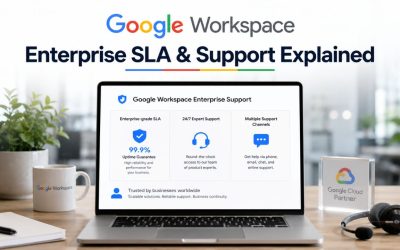
Google’s premium support tiers, available as an add-on across Enterprise editions, provide 24/7 coverage with defined response-time targets that scale by case priority, and Google’s support infrastructure is itself distributed across regional centers rather than centralized in a single time zone. This matters for a genuinely global organization because a support ticket filed from an APAC office isn’t queued behind a US business-hours backlog; it routes to whichever support center is active, which is the practical meaning of “follow-the-sun” in this context rather than a marketing phrase without operational substance.
That said, response-time SLAs are defined by case priority level, not by the customer’s region, so a P1 outage gets the same contractual response-time commitment everywhere covered support exists; the follow-the-sun architecture is about coverage continuity, not regionally tiered service quality. Organizations negotiating enterprise support agreements should confirm the specific priority-level definitions and response windows currently published, since these terms are the kind of detail that shifts with contract renewals and shouldn’t be assumed static from a prior year’s agreement.
Building Internal Escalation Paths That Match Google’s Support Model
A common failure mode in global rollouts is designing an internal help-desk escalation process around a single home-office time zone, which then creates a bottleneck between Google’s genuinely 24/7 support and an internal IT team that only triages during one region’s business hours. Aligning internal escalation staffing, even lightly, with an on-call rotation rather than full regional teams, to match the continuity Google’s support already provides, closes a gap that otherwise undermines the value of paying for premium support in the first place.
This is one of the areas where a deployment partner’s experience tends to matter most: patterns around where internal escalation gaps typically surface, usually at the handoff between regional IT teams rather than in Google’s support response itself, show up repeatedly across large rollouts, and catching them during initial support-model design is considerably cheaper than discovering them during a live incident.
Why Region and Support Decisions Belong in a Single Deployment Plan
Getting the support model right depends on getting the underlying region and edition decisions right first, and that’s where a rollout benefits from partner-side project management rather than a self-serve trial-and-error approach. Hiya Digital, as an Authorized Reseller and Implementation Partner, works through data region mapping, edition selection by business unit, and support-model design as a coordinated project rather than a series of disconnected admin console changes, which matters most for procurement teams weighing internal bandwidth against the compliance risk of getting a multi-region deployment wrong on the first attempt.

Sub-Processor Disclosure and Vendor Risk Documentation Across Regions
A multi-region compliance posture is incomplete without visibility into who else touches customer data beyond Google itself, since most privacy frameworks a multinational tenant answers to require disclosure of sub-processors, not just the primary vendor.
Reviewing Google’s Published Sub-Processor List as Part of Regional Due Diligence
 Reviewing Google’s Published Sub-Processor List as Part of Regional Due Diligence
Google publishes a list of sub-processors it engages to support Workspace services, and this list is a standard artifact that compliance and procurement teams should review against each region’s specific regulatory requirements before finalizing a deployment. Some frameworks, particularly certain government contracting regimes, restrict which sub-processors may access in-scope data at all, making this review a gating step rather than a background formality for organizations operating under those stricter regimes.
Reviewing this list once at contract signing and never again is a common gap: Google updates the list periodically as vendor relationships change, and a compliance program that doesn’t monitor for updates can drift out of alignment with its own documented commitments without anyone noticing until an audit surfaces it.
Building a Vendor Risk Register That Maps to Each Region’s Requirements
Large organizations operating across multiple jurisdictions typically need a vendor risk register that maps Google’s sub-processor list and any relevant certifications held by each sub-processor against the specific disclosure and restriction requirements of each region in which the organization operates. A single generic risk assessment rarely satisfies every jurisdiction’s specific documentation format. This register becomes particularly important during customer or partner due diligence questionnaires, where a multinational vendor is frequently asked to demonstrate not just its own compliance posture but also visibility into its sub-processors’ posture.
Maintaining this register as a living document, updated whenever Google’s sub-processor list changes or a new region enters scope, is considerably less costly than reconstructing it reactively in response to a specific audit or customer request. It’s the kind of ongoing governance task that benefits from being assigned to a specific owner rather than left as an unowned responsibility between IT and legal.
Latency, Network Architecture, and Regional Performance
Data region selection and network performance are frequently conflated, and clearly separating them early in a global rollout plan is one of the more useful things it can do.
Why Selecting a Data Region Doesn’t Automatically Improve Speed
Google’s own documentation is direct on this point: choosing a specific data region does not improve performance or fine-tune network routing for end users in that region; the setting governs where data rests and, for Enterprise Plus, where it’s processed, but it doesn’t reroute Google’s global network to prioritize a particular geography’s traffic. An IT team that selects the Europe data region expecting faster load times for European users is solving a different problem than the one that setting addresses, and that mismatch in expectations tends to surface as a support ticket rather than a planning conversation if it isn’t clarified upfront.
Actual latency for Workspace applications depends primarily on Google’s global network architecture and the user’s proximity to Google’s edge infrastructure, which operates independently of data region policy. Organizations concerned specifically about end-user performance in a given region should evaluate that as a separate technical question, network path, ISP peering, and local connectivity quality, rather than expecting the compliance-oriented data regions feature to resolve it as a side effect.
Planning Around Regional Outage and Failover Scenarios
Google’s data regions documentation notes a specific edge case worth building into contingency planning: in rare circumstances, natural disasters or other events outside Google’s control, users outside a selected data region might temporarily lose access to data that’s been geographically pinned to that region. For a genuinely global organization, this is a real operational trade-off against the compliance benefit of regional pinning, and it should be an explicit conversation with business continuity stakeholders rather than a footnote discovered after an incident.
Organizations with strict business continuity and data residency requirements need to deliberately weigh these two goals against each other. Maximal residency strictness can, in edge cases, reduce access resilience, and there’s no single configuration that maximizes both simultaneously. Documenting this trade-off as a conscious decision, rather than an unexamined default, is the kind of detail a compliance-literate audit committee will specifically ask about.
Assured Controls and Advanced Sovereignty Add-Ons
Beyond the data regions feature included with Enterprise Plus, Google offers additional add-on layers for organizations whose regulatory environment demands controls beyond the base Enterprise offering.
What Assured Controls and Assured Controls Plus Add on Top of Enterprise Plus
Assured Controls and its more advanced Assured Controls Plus tier extend the sovereignty capabilities already present in Enterprise Plus, adding features such as more granular administrative reporting, additional support-access restrictions, and, at the Plus level, capabilities aimed at organizations facing the strictest government or regulated-industry sovereignty requirements. These are positioned by Google as an add-on layer rather than a replacement for the base data regions capability, meaning an organization typically needs Enterprise Plus as the underlying edition before Assured Controls becomes a relevant purchase decision at all.
The reporting improvements specifically matter for large organizations managing residency across many organizational units: Assured Controls customers get access to more advanced dashboard reporting, including breakdowns by data region version and applied policy, than the streamlined reporting available to standard Enterprise Plus customers, which becomes operationally significant once an organization is managing dozens or hundreds of distinct organizational units with potentially different regional policies applied.
Deciding Whether the Add-On Tier Is Justified for a Given Organization
Not every multinational organization needs Assured Controls; it’s positioned for customers in government contracting requirements, highly regulated industries, or jurisdiction-specific sovereignty mandates that meaningfully go beyond GDPR-style transfer-mechanism compliance. An organization whose cross-border obligations are satisfied by standard data regions and a properly executed DPA is likely paying for capabilities it won’t use if it adds Assured Controls reflexively rather than in response to a specific, documented requirement.
The decision is best made by mapping each business unit’s actual regulatory exposure against Google’s published feature comparison for the add-on, rather than defaulting to the higher tier because it sounds more comprehensive, a pattern that shows up often enough in large-organization procurement that it’s worth naming directly: sovereignty add-ons purchased without a specific mandate behind them tend to sit unused. At the same time, the underlying Enterprise Plus data region configuration does the actual compliance work.
Governance Structures for Multi-Region Admin Management
Technical controls only work if the administrative structure managing them matches the organization’s actual regional complexity, and this is where many global rollouts create friction unrelated to Google’s platform itself.
Organizational Unit Design for Region-Specific Policy Enforcement
Google Workspace’s organizational unit (OU) structure is the mechanism through which region-specific data policies, security settings, and licensing are applied at scale, and a poorly designed OU hierarchy is one of the most common root causes of the coverage gaps described earlier in this post. A structure that mirrors the org chart rather than the actual regulatory boundaries an organization needs to enforce tends to require constant manual exceptions, since business units and compliance jurisdictions rarely align perfectly with reporting lines.
The more durable pattern for global deployments is designing OUs around regulatory and residency boundaries first, then layering department- or team-level sub-OUs beneath that structure, which keeps data region policy inheritance clean and makes it possible to audit “which users are covered by which residency policy” as a straightforward console query rather than a manual cross-reference exercise involving spreadsheets pulled from HR systems.
Delegated Administration Across Regional IT Teams
Large multinational deployments rarely centralize all administrative control in a single headquarters IT team; regional IT staff typically need delegated admin rights scoped to their own organizational units, without gaining visibility or control over other regions’ data. Google Workspace’s admin roles support this through custom role definitions that can be precisely scoped to specific organizational units and privileges, which is the mechanism that lets a regional IT administrator manage their own region’s users without becoming a de facto global super-admin by default.
Getting this delegation model wrong in either direction creates real risk: too little delegated authority recreates the time-zone bottleneck problem described in the support section. At the same time, too much creates unnecessary cross-region visibility into data that a regional privacy officer may specifically need to be walled off. The right balance is typically established during initial deployment planning, since retrofitting a delegation model after regional admin habits have already formed is considerably more disruptive than designing it correctly the first time.
Planning a Phased Multi-Region Rollout
Sequencing matters as much as the individual technical decisions covered above; a rollout that tries to finalize every region’s configuration simultaneously tends to surface conflicts late, when they’re expensive to fix.
A Realistic Sequencing Approach for Multi-Thousand-Seat Deployments
A phased approach that starts with the organization’s most regulatorily complex region, typically the one with the strictest residency or processing mandate, tends to surface configuration requirements that inform every subsequent region’s rollout, rather than discovering those requirements piecemeal across multiple parallel launches. Treating the first region as a template to be adapted, rather than treating each region as an independent project, meaningfully reduces the total configuration and testing effort across a multi-thousand-seat deployment.
For organizations in the multi-thousand-seat range, a realistic timeline runs from initial OU and data region policy design through pilot-group testing in the lead region, staged rollout to remaining regions, and a stabilization period before considering the deployment complete, compressing this to hit an arbitrary go-live date is one of the more common sources of post-launch remediation work, since residency and access-control misconfigurations discovered after user data has already been created are considerably harder to correct than the same issues caught during pilot testing.
Documentation and Change Management Across Regional Stakeholders
 Documentation and Change Management Across Regional Stakeholders
A multi-region rollout typically touches more stakeholders than a single-country deployment ever does: regional legal counsel, works councils in jurisdictions that require their involvement, and local IT liaisons, each of whom needs visibility into how the configuration affects their specific region. Maintaining a single source-of-truth document that maps each organizational unit to its assigned data region policy, edition, and any add-ons applied gives every stakeholder group a shared reference, rather than relying on institutional memory scattered across regional teams.
This documentation also becomes the primary artifact regulators and auditors will request during any future compliance review, which makes maintaining it accurately throughout the rollout, rather than reconstructing it after the fact, one of the highest-leverage activities in the entire project. The table below summarizes how policy scope typically differs across the three edition tiers most relevant to a multi-region enterprise decision.
| Capability | Enterprise Standard | Enterprise Plus | Enterprise Plus + Assured Controls |
|---|---|---|---|
| Data region storage coverage | Yes | Yes | Yes |
| In-region processing coverage | No | Yes | Yes |
| Advanced sovereignty reporting dashboard | Streamlined only | Streamlined only | Advanced (Versions + Policies breakdown) |
| Client-side encryption for digital sovereignty | Not included | Included | Included |
| Positioned use case | Standard enterprise deployments without strict processing residency needs | Organizations with GDPR-adjacent or sovereignty-sensitive processing requirements | Government contracting or highly regulated sectors requiring maximal control granularity |
Frequently Asked Questions
Does selecting a Google Workspace data region guarantee full GDPR compliance?
No. Data regions are a proactive control that goes beyond what GDPR strictly requires; the regulation’s own transfer mechanisms, including standard contractual clauses, can satisfy legal requirements without any geographic storage restrictions. Google’s documentation explicitly states that customers are not required to use data regions to comply with GDPR. Full compliance depends on a broader set of controls: an executed data processing addendum, a documented lawful basis for processing, breach notification procedures, and functioning data subject rights workflows across every jurisdiction in which the organization operates. Treating data region selection as a complete compliance solution, rather than as a single control among several, is a common gap that auditors identify during formal reviews of multinational Workspace deployments.
What’s the difference between Enterprise Standard and Enterprise Plus for data residency purposes?
Enterprise Standard supports data region policies for storage, specifying where covered data at rest, including backups, resides. Enterprise Plus extends that coverage to include in-region processing, meaning the actual computation on that data, and adds client-side encryption as part of its digital sovereignty capabilities. For organizations whose regulatory exposure is tied to where processing occurs, not just where data is stored, Enterprise Standard’s storage-only coverage leaves a gap that only Enterprise Plus can close. This distinction is frequently misunderstood during procurement, where “Enterprise” is treated as a single, undifferentiated tier rather than as two editions with materially different sovereignty coverage.
Can different regional offices within the same organization have different data region policies?
Yes. Google Workspace applies data region policies at the organizational unit level, which means a single tenant can assign different regions, or no preference at all, to different organizational units based on their specific regulatory exposure. A European entity might operate under strict EU-only storage and processing requirements, while a US-based unit with no equivalent mandate operates under looser requirements. This flexibility depends on organizational unit structure being designed around regulatory boundaries in the first place; an OU hierarchy that mirrors the org chart rather than jurisdictional lines makes this kind of differentiated policy harder to apply cleanly and audit later.
Does choosing a data region improve application speed for users in that region?
No, and this is one of the most common misconceptions in multi-region planning. Google’s own documentation states directly that selecting a data region doesn’t improve performance or optimize network routing; it governs where data physically rests and, for Enterprise Plus, where it’s processed. Actual application latency depends on Google’s global network architecture and a user’s proximity to Google’s edge infrastructure, which functions independently of the data region setting. Organizations concerned about end-user performance in a specific region should treat that as a separate network and connectivity question rather than expecting data residency configuration to resolve it.
What happens to data access if a data region experiences an outage or disaster event?
Google’s documentation notes that in rare cases, natural disasters or events outside Google’s control, users outside a selected data region might temporarily lose access to data pinned to that region. This is a genuine trade-off between strict residency and access resilience that global organizations should weigh deliberately rather than overlook. Business continuity planning for a multi-region Workspace deployment should explicitly account for this scenario, particularly for organizational units where both strict data residency and high availability are required simultaneously, since no single configuration can maximize both goals.
Are Assured Controls necessary for every multinational organization using Google Workspace Enterprise?
No. Assured Controls and Assured Controls Plus are add-on tiers built on top of Enterprise Plus, specifically designed for organizations facing government contracting requirements or highly regulated industry mandates that go beyond standard GDPR-style compliance. Organizations whose regulatory exposure is satisfied by Enterprise Plus’s base data region and processing coverage, combined with a properly executed data processing addendum, typically don’t need the add-on. The decision should be based on a specific, documented regulatory requirement mapped to Google’s published feature comparison, rather than being added by default on the assumption that more coverage is automatically better.
How does Google’s support model handle time zone coverage for a global Workspace deployment?
Google’s premium enterprise support tiers provide 24/7 coverage through a distributed network of regional support centers, so a case filed outside any single region’s business hours still routes to an active support team rather than queuing until headquarters opens. Response-time commitments are defined by case priority level rather than by the customer’s region, meaning a top-priority case receives the same contractual response window globally. Organizations should still confirm the specific priority-level definitions and response windows in their current support agreement, as these terms are negotiated and can vary across contracts and renewal cycles.
Do standard contractual clauses still matter if an organization has enabled data regions?
Yes. Data regions and standard contractual clauses (SCCs) address different aspects of cross-border data handling and aren’t substitutes for each other. SCCs, incorporated into Google’s data processing addendum, provide the legal basis for any cross-border transfer that still occurs, including legitimate support and maintenance access, or organizational units deliberately left on a “no preference” region setting. An organization should confirm its current DPA is properly executed at the organizational level rather than assuming coverage from a generic terms-of-service acceptance, since this is the specific document regulators and auditors will ask to see.
What is Access Transparency and why does it matter for a multi-region deployment?
Access Transparency is a feature available to qualifying Enterprise customers that generates near-real-time logs whenever Google personnel access customer content for support or maintenance, including the justification and the specific action taken. For organizations managing data residency commitments, it provides auditable evidence that no unauthorized cross-border access occurred outside the boundaries established by a data region policy. Because logging isn’t retroactive, organizations should enable Access Transparency early in a multi-region rollout rather than waiting until a specific audit or customer due diligence request makes it urgent. A gap in prior-period coverage can’t be reconstructed after the fact.
How long does a phased multi-region rollout typically take for a large enterprise?
Timelines vary by seat count and regulatory complexity. Still, a realistic sequence for a multi-thousand-seat deployment runs from organizational unit and data region policy design, through pilot-group testing in the most regulatory-complex region first, to staged rollout across the remaining regions, followed by a stabilization period. Compressing this sequence to hit an arbitrary go-live date is a common source of post-launch remediation, since misconfigured residency or delegated-admin settings are considerably harder to correct once user data already exists under the wrong policy. Starting with the strictest-requirement region as a template for subsequent regions tends to reduce total rollout effort compared to running every region as an independent project.
Glossary
Data Region: A Google Workspace Admin console setting that assigns covered data to a specific geographic storage location (United States, Europe, or no preference) for a given organizational unit.
GDPR (General Data Protection Regulation): The European Union’s primary data protection law, governing personal data belonging to individuals in the EU regardless of where the processing organization is based.
DPA (Data Processing Addendum): The contractual document between Google and a Workspace customer that governs how customer personal data is processed, including the incorporation of standard contractual clauses for international transfers.
SCCs (Standard Contractual Clauses): A legal mechanism, incorporated into Google’s DPA, that provides a lawful basis for transferring personal data across borders, independent of physical data storage location.
Assured Controls / Assured Controls Plus: Add-on tiers built on top of Enterprise Plus that extend digital sovereignty and administrative reporting capabilities for organizations with heightened regulatory or government-contracting requirements.
Access Transparency: A logging feature available to qualifying Enterprise customers that records Google personnel’s access to customer content, including justification and action taken, in near real time.
OU (Organizational Unit): The structural unit within Google Workspace’s Admin console used to apply policies, licensing, and delegated administrative access to specific groups of users.
ISO/IEC 27001: An international standard for information security management systems; Google holds this certification for the infrastructure, people, and processes serving Google Workspace.
SOC 2 / SOC 3: Independent third-party audit reports assessing an organization’s controls over security, availability, and confidentiality, issued for Google Workspace regularly.
Follow-the-Sun Support: A support model in which coverage is handed off across geographically distributed support centers so that service continuity is maintained across time zones without relying on a single region’s business hours.
The Hiya Digital Team is a collective of IT infrastructure specialist engineers, certified systems administrators, and cloud architects driven by a singular mission: building corporate communication systems that just work. As an Authorized Google Partner, the team handles complex global hosting deployments, secure email migrations, and advanced data compliance architectures for businesses across 40+ countries.
With over two decades of technical experience spanning custom premium business email configurations, OX AppSuite deployments, and enterprise-level network security, the Hiya Digital Team writes to demystify domain infrastructure. Their content focuses on actionable technical strategies, anti-phishing security protocols, and seamless cloud collaboration setup, all backed by real-world deployment experience and 24/7 technical support accountability.